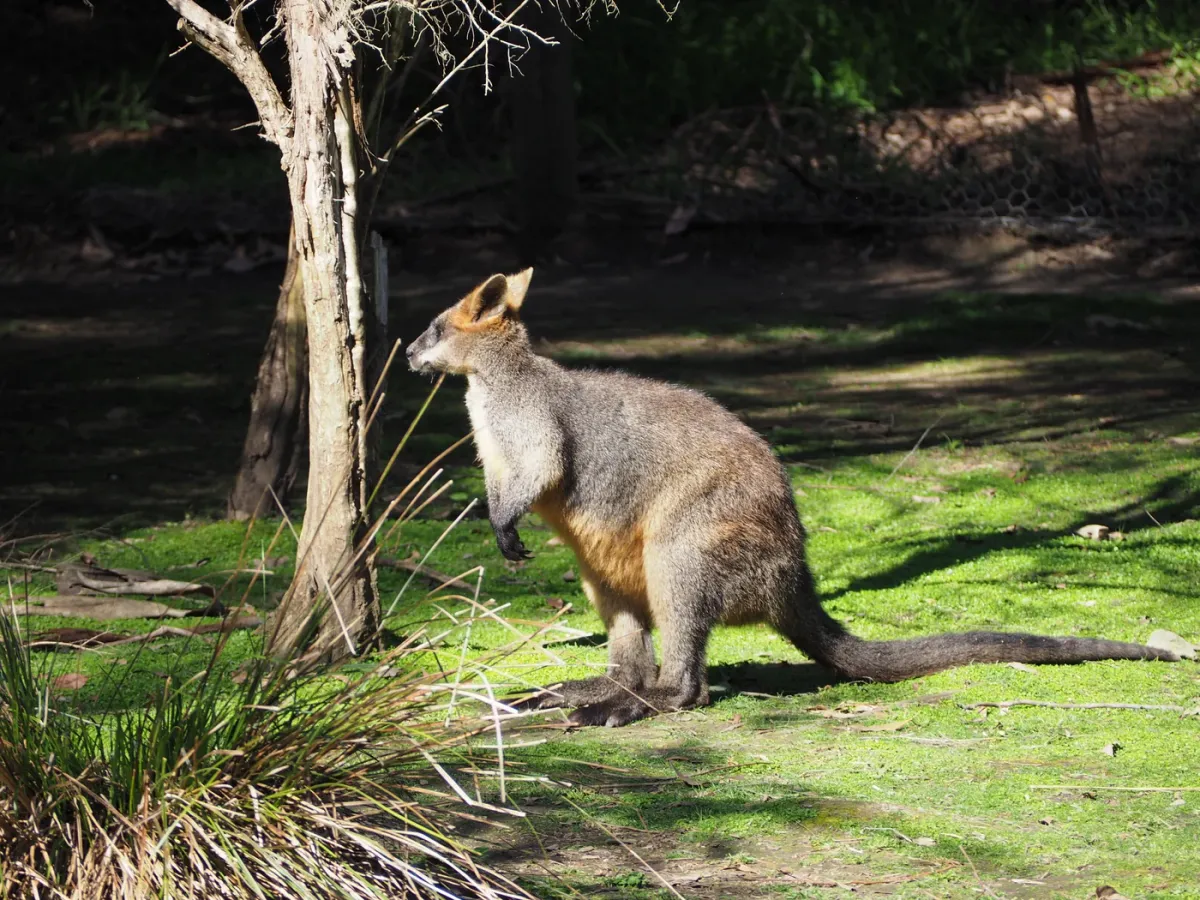

A dark coat, a cheek stripe and a hidden animal
A Swamp Wallaby usually has a dark coat, a lighter cheek stripe and yellowish to reddish tones underneath. NSW National Parks describes dense understorey in rainforest, woodland and dry sclerophyll forest along eastern Australia. Despite the name, a wet swamp is not a required setting for every sighting.
Compare the whole visible animal with a Red-necked Wallaby, whose rusty shoulders and upper back accompany a generally greyer appearance. A dark photograph of one small kangaroo is insufficient: vegetation, light and the angle may hide the useful features.
Rocky surroundings do not decide the species. NSW National Parks describes the Brush-tailed Rock-wallaby’s bushy tail and thick brown body fur in rocky escarpments, while Swamp Wallabies use dense vegetation. Keep the cheek, tail and broad location in the record, and leave the identification open if those features cannot be seen.
Sources: NSW National Parks: Swamp Wallaby · Bundaberg Regional Council: Swamp and Red-necked Wallabies · NSW National Parks: Brush-tailed Rock-wallaby features and habitat
Browsing in cover is different from grazing a lawn
Swamp Wallabies eat varied plant material, including ferns, heath and shrubs. Their broad premolar helps process coarse plants. This differs from treating every macropod as a specialist lawn grazer.
NSW National Parks describes activity mainly between dusk and dawn and a mostly solitary life, though several may gather to feed. One animal feeding alone is therefore not necessarily isolated from a required permanent mob.
The council account notes a characteristic low-headed hopping posture with the tail extended. That can support a comparison if already observed; it is not a reason to flush an animal from shelter to watch it run.
Sources: NSW National Parks: Swamp Wallaby · Bundaberg Regional Council: Swamp and Red-necked Wallabies
More than one stage of young at once
University of Melbourne researchers reported a reproductive study in 2020 that followed pregnancy and mating in ten female Swamp Wallabies. The females could conceive another embryo shortly before an existing pregnancy ended; the new embryo then entered developmental arrest associated with suckling.
That finding explains an unusual reproductive strategy. It does not establish the reproductive state of every wild female seen from a path. A female may support different developmental stages, and young at foot can still suckle after leaving the pouch.
For observation, the useful distinction is dependence, not a guessed birth date. Do not approach a mother or separate a youngster to check its pouch use, teeth, age or sex. Absence of a visible joey also does not prove absence of dependent young.
Sources: University of Melbourne: Swamp Wallaby reproduction study, 3 March 2020
Keep the cover and the encounter intact
Watch from a distance and let the animal retreat into vegetation. The reference image is from Healesville Sanctuary and is labelled as captive; it illustrates the species rather than documenting a local wild population.
Do not feed a wallaby or approach one that seems sick or injured. Contact licensed wildlife help when concerned. An existing photograph and a description of the habitat and visible traits are enough to begin an identification discussion without disturbing it.
Sources: Queensland Government: living with kangaroos and wallabies