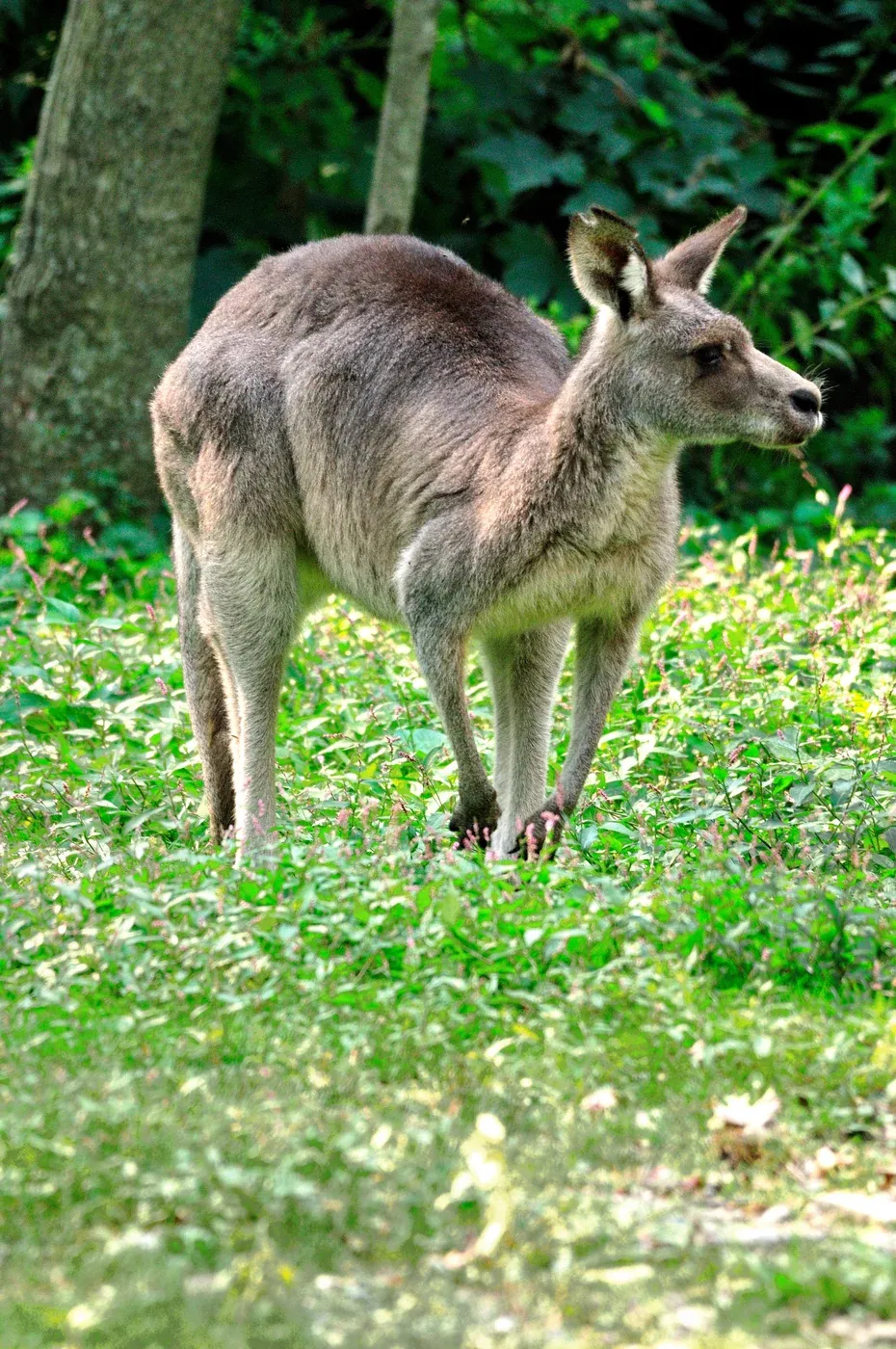

A grey coat is the beginning of the comparison
An Eastern Grey Kangaroo has soft-looking grey fur, a darker face and a dark tail tip. Its powerful hind feet, shorter forelimbs and long balancing tail identify the general kangaroo form; they do not by themselves separate it from the other large kangaroos.
Western Greys deserve particular care where the ranges overlap. Queensland’s comparison describes the Western as having a darker brown, broader-looking face, strongly contrasting pale areas and a pale upper-thigh patch. Eastern Greys tend to be more evenly light overall, with dark hair around the eyes. A distant silhouette cannot supply those details.
Use the face and the rest of the body in good light, together with the broad region. Do not move closer or chase an animal to reveal the thigh. Leave a poor view as an unidentified grey kangaroo rather than treating a common name as certainty.
Scroll sideways, or focus the table and use arrow keys, to compare all columns.
| Question | Compare | Limit |
|---|---|---|
| Eastern or Western Grey? | Face contrast, eye outline and upper-thigh markings | Lighting and angle can hide the clues. |
| Adult male or female? | Adults differ in typical size | Size is not a reliable standalone label for an unmeasured animal. |
| Young or independent? | Pouch use and association with a mother | Leaving the pouch is not the same as weaning. |
Sources: Australian Museum: Eastern Grey Kangaroo · Queensland Government: Eastern and Western Grey comparison
Mainland distribution does not mean every Tasmanian place
Eastern Greys occur widely in eastern Australia, including Tasmania. They use woodland, forest and more open feeding areas; shelter and grazing ground can occur alongside one another.
In Tasmania the same species is called the Forester Kangaroo. NRE Tasmania describes isolated populations in central and north-eastern parts of the state, including well-known national-park populations. It is therefore misleading to turn a broad Tasmania range label into a promise of kangaroos at every site.
The Tasmanian account describes grassy forest and woodland and feeding especially early and late in the day, though animals may also feed by day. A resting animal in shade fits this daily pattern; the time alone cannot establish whether it is well.
Sources: Australian Museum: Eastern Grey Kangaroo · NRE Tasmania: Forester Kangaroo
A mob and a joey answer different questions
Eastern Greys graze mainly on grasses. Several animals gathering to feed need not form a tightly fixed group. In the Tasmanian account, small family groups can join loosely associated larger mobs.
Young develop in the pouch, then continue suckling after spending time outside it. Pouch emergence is one stage, not instant independence. Do not approach a female to inspect the pouch or separate a young animal from her.
Breeding dates also need their region. The Museum describes year-round breeding with a summer peak, while the Tasmanian Forester account gives an autumn peak. These summaries are not interchangeable calendars for every local mob. NRE also records clucking contact sounds and a guttural cough in alarm.
Sources: Australian Museum: Eastern Grey Kangaroo · NRE Tasmania: Forester Kangaroo
Watch without changing the encounter
Keep your distance and do not feed kangaroos: repeated handouts can encourage approaches and conflict. Keep an unobstructed space between a mother and young. For an injured or unwell animal, seek licensed wildlife help instead of approaching it.
A useful observation records the broad place, light, face pattern, visible markings and what the animal was already doing. The comparison photographs are reference examples, including a labelled captive view; they are not an invitation to get equally close.
Sources: Queensland Government: living with kangaroos and wallabies