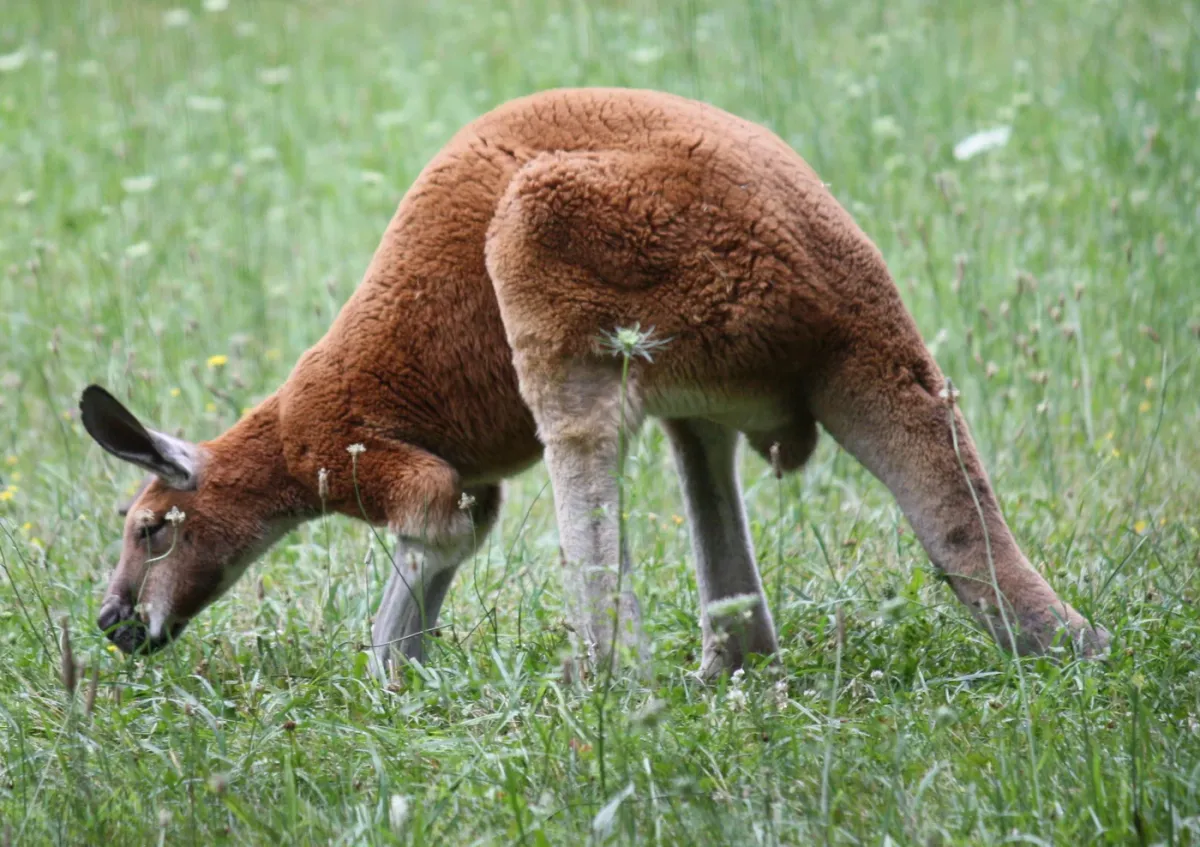

Why colour alone can name the wrong animal
The Red Kangaroo’s name does not mean that every individual is bright red. The Australian Museum describes males as tending towards orange-red and females as often blue-grey. Colour is a tendency within the species, not a dependable first step for separating it from a grey kangaroo.
Look instead for the black-and-white cheek markings and the broad pale stripe running from the corner of the mouth towards the ear. The pale underside and overall build support the comparison. A partly hidden face, strong shade or a poor photograph may still leave the species unresolved.
Adult males are typically larger than females, but a small individual could be a younger animal or an adult of the smaller sex. Keep species, age and sex as separate conclusions. No single view gives permission to approach or measure a wild kangaroo.
Sources: Australian Museum: Red Kangaroo
Open country, rainfall and food
Red Kangaroos occupy arid and semi-arid mainland Australia, using open plains and a range of grassland, shrubland and open woodland settings. Their diet is mainly grasses, with other herbaceous plants and shrub leaves also used.
The South Australian management account describes a flexible response to food conditions. Animals can move more widely when drought changes feed availability; green growth is also important for breeding. Finding kangaroos near a new flush does not by itself demonstrate a lasting rise in the local population.
Daytime shade and early or late activity are useful context. The South Australian wildlife-park account describes resting out of the hottest sun and increased feeding around dawn and dusk. These are patterns to recognise, not a clock that guarantees a sighting or proves a stationary animal is healthy.
Sources: Australian Museum: Red Kangaroo · SA Government: Kangaroo Management Plan 2025–2029, species biology · Cleland Wildlife Park: Crepuscular Creatures, April 2025
Pouch life is only part of dependence
A Red Kangaroo joey can spend time outside the pouch before it is weaned. Seeing a young animal at foot is therefore not evidence that it has been abandoned. Leave room around the pair rather than encouraging the youngster away from its mother.
Embryonic diapause is a different stage: development of an embryo can pause while another young occupies the pouch or conditions are poor. The South Australian account links reproduction to available green feed, with breeding reduced during severe drought. Do not turn the familiar idea of a “paused pregnancy” into a claim that every photographed female has the same reproductive state.
These reproductive stages explain a life history. They cannot diagnose pregnancy, sex or age from coat colour and do not provide a method of hand-rearing a joey.
Sources: Australian Museum: Red Kangaroo · SA Government: Kangaroo Management Plan 2025–2029, species biology
A comparison needs context, not a closer encounter
The reference photograph shows a captive animal at Binder Park Zoo, not a wild sighting in its natural range. Compare its face markings with the other species guides, and keep the photo’s setting separate from the distribution account.
Do not offer food, approach a resting animal or put yourself between a mother and young. If an animal may be injured, call licensed help. For identification, a broad region and an existing clear view are more useful than a risky close encounter.
Sources: Queensland Government: living with kangaroos and wallabies