
Use a sequence of colours, not simply “colourful parrot”
A typical Rainbow Lorikeet has a blue head, yellow-green collar, orange-yellow breast, blue belly and green wings and back. Adult bills are orange-red. Male and female plumage is similar, so the brighter of two birds is not automatically male.
A Scaly-breasted Lorikeet has an all-green head and yellow-edged breast feathers instead of that blue-head and warm-breast combination. In northern Australia, consider Red-collared Lorikeet too: its orange-red collar differs from the Rainbow’s yellow-green band. Use region and the whole pattern together; a single green wing seen through leaves leaves several possibilities.
Scroll sideways, or focus the table and use arrow keys, to compare all columns.
| Feature | Rainbow Lorikeet | Alternative to compare |
|---|---|---|
| Head and breast | Blue head; orange-yellow breast | Scaly-breasted: green head; yellow-scaled breast |
| Collar behind head | Yellow-green | Red-collared: orange-red, especially relevant in northern Australia |
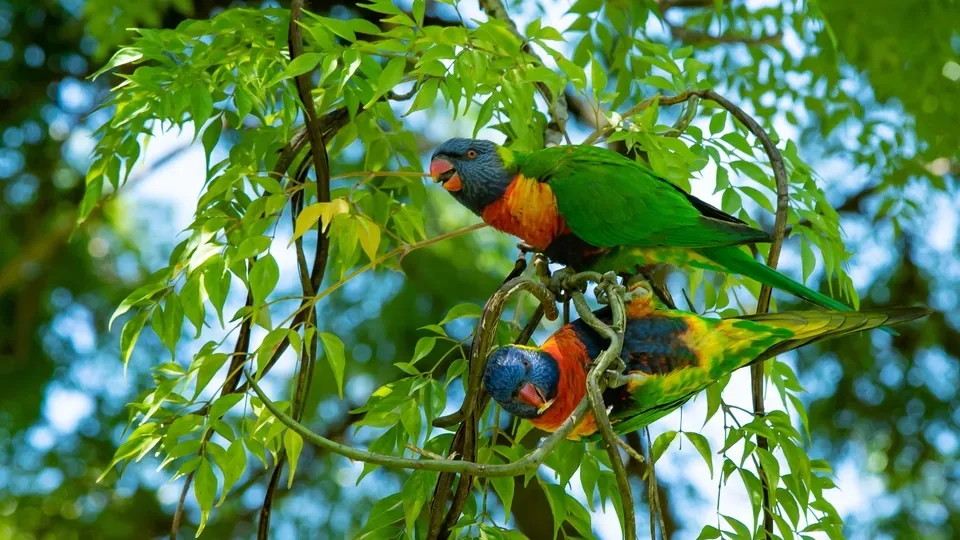
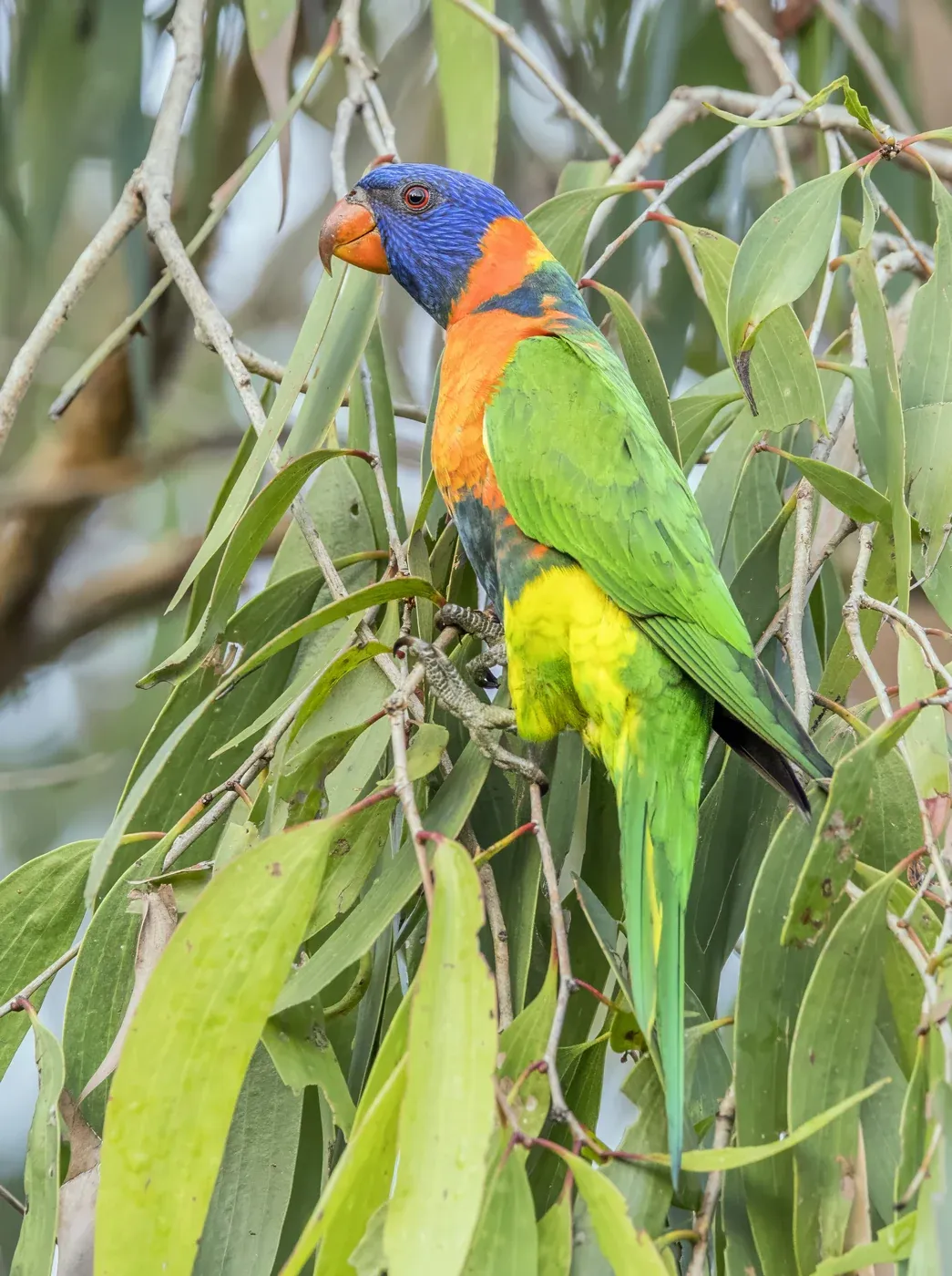

Sources: BirdLife Australia: Rainbow Lorikeet and call recording · Australian Museum: Scaly-breasted Lorikeet · World Parrot Trust: Red-collared Lorikeet
A darker bill can be an age clue, not a sex clue
Young Rainbow Lorikeets can have darker, dusky bills and browner irises than adults. The Australian Bird Study Association describes a progression towards the brighter adult bill and iris, with immature plumage capable of appearing adult-like. A bright body therefore does not, on its own, settle age.
Adult males and females look alike in plumage, with overlapping body measurements. Size in two unrelated photographs is especially unhelpful. Keep separate notes for species, possible age and unassessable sex rather than treating “juvenile or female” as two competing answers. Older technical accounts place these birds within a broader Rainbow Lorikeet complex; this guide follows BirdLife’s Trichoglossus moluccanus usage.
Sources: Australian Bird Study Association: Rainbow Lorikeet, historical taxonomy and age clues · BirdLife Australia: Rainbow Lorikeet and call recording
Flowers connect the feeding route
Rainbow Lorikeets use wooded habitats including forest, rainforest and well-treed suburbs. Nectar and pollen are important foods; fruit, seeds and some insects are also taken. A sequence of flowering trees can provide foraging opportunities beyond one garden.
Fast-moving noisy groups and communal roosts make birds conspicuous, but repeated arrivals can be the same individuals. If contributing to a structured count, follow that project’s method rather than adding every arrival. Watching food use does not require placing a feeding tray: routine artificial feeding can concentrate birds and create nutritional and disease risks.
Sources: BirdLife Australia: Rainbow Lorikeet and call recording · WIRES: Let nature feed itself
Native somewhere is not native everywhere
Rainbow Lorikeets are familiar in eastern Australia, while the established Perth population is outside its natural range. WA’s DPIRD treats them as a declared pest south of the Kimberley and explains the competition and management concerns. That local context should not be applied indiscriminately across Australia.
For an unusual WA sighting, use the department’s current reporting route. Do not capture, relocate or release a bird yourself. Its regional status and a photograph do not supply handling expertise. The northern Red-collared Lorikeet is a separate regional comparison; older sources using broader taxonomy need to be interpreted carefully.
Sources: BirdLife Australia: Rainbow Lorikeet and call recording · WA DPIRD: Rainbow lorikeet regional status and reporting · World Parrot Trust: Red-collared Lorikeet
Hollows, young birds and the sound of a flock
Both parents prepare the nesting cavity and feed young; the female incubates. The nest is usually in a tree hollow with decayed, chewed wood. DPIRD’s April–December breeding description is for its WA account, not a fixed calendar for the whole eastern range.
Frequent screeching and chattering may come from birds in flight, feeding or gathering at a roost. BirdLife provides a Fred Van Gessel recording as a listening reference. A single sound is less reliable than the sound plus a visible head-and-breast pattern. Listen without playback towards wildlife, and keep clear of nesting hollows.
Sources: BirdLife Australia: Rainbow Lorikeet and call recording · WA DPIRD: Rainbow lorikeet regional status and reporting
The useful next step is a careful record
Record broad region, head colour, collar colour, breast pattern and bill colour if visible. Compare the existing photograph before considering a closer view. It is fine to leave the bird as an unidentified lorikeet when foliage hides the diagnostic features.
A young parrot on the ground, an injured bird or a known collision needs prompt advice from a licensed rescuer or vet. Do not offer food, force water or handle it on the strength of an identification. Keep people and pets back while arranging professional help.
Sources: WIRES: Helping chicks · WIRES: Let nature feed itself