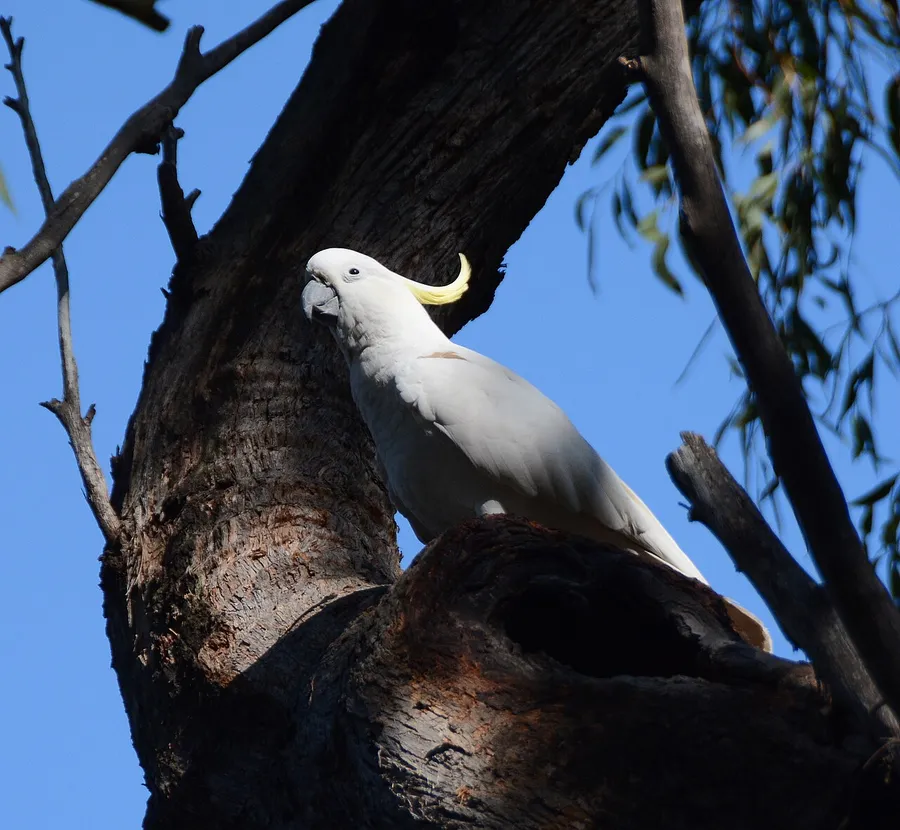

Recognise the bird
A large white parrot with a yellow crest and a dark bill is a useful starting point. Sulphur-crested Cockatoos also show yellow beneath the wings. Adults and young birds look similar, and the sexes are not easy to distinguish from a casual view. Observe the whole bird rather than relying on one raised crest.
Where they occur in Australia
The Australian Museum describes a range across the northern and eastern mainland and Tasmania, with an established population around Perth. They use wooded habitats and live around towns and cities. A bird common in one part of Australia is not necessarily naturally widespread everywhere else.
They generally remain in the same area through the year. A conspicuous visiting flock can still be part of a local population.
What a flock is doing
Cockatoos often feed together on seeds and other plant material, and their diet can include insects. While birds feed on the ground, another may watch from a tree and call when danger approaches.
Chewing is part of their behaviour too. The Victorian Government's fact sheet explains that continuously growing bills need maintenance; birds clip twigs and leaves even when not eating them. Notice whether a bird is swallowing material or simply dropping it. The two observations tell different stories.
Sources: Victorian Government: Sulphur-crested Cockatoo fact sheet (2017)
Nesting follows different calendars
Eggs are laid in a tree hollow, and both parents incubate and care for the young. The Australian Museum gives May to September for breeding in the north and August to January in the south. A single Australia-wide 'spring nesting season' misses that difference. Keep your distance from occupied hollows.
What bin-opening research tells us
An Australian National University research project describes how bin-opening spread among Sulphur-crested Cockatoos in Sydney. Researchers used community reports to map the behaviour, with subsequent work around southern Sydney and North Wollongong examining how birds respond to bin protection.
This is a documented example of learning in particular urban populations. It does not establish that every cockatoo knows the technique. If you observe it, record the location broadly, date and sequence of actions; avoid creating a food opportunity for a closer photograph.
Sources: Australian National University: Spread of innovation in urban sulphur-crested cockatoos
Share the neighbourhood without supplying scraps
Sutherland Shire Council advises residents not to feed cockatoos, to avoid overfilling rubbish bins and to keep lids closed. Secure food waste and take picnic rubbish home when a suitable bin is unavailable.
If birds are chewing building materials, seek local wildlife advice about the particular problem. Useful observations include the surface being chewed, whether food is nearby and the times birds visit. Removing an accessible food reward is a practical first step.
Sources: Sutherland Shire Council: Sulphur-crested Cockatoos
Protect habitat for future nesting
Mature trees can contain the hollows these birds need. The Victorian fact sheet recommends retaining old trees and planting locally native trees for future habitat. Where a tree needs safety assessment, seek qualified local advice rather than assuming an occupied hollow can simply be replaced by a young tree.
Plan planting around the available space and local conditions. Habitat work should benefit the wider bird community as well as the loudest flock.
Sources: Victorian Government: Sulphur-crested Cockatoo fact sheet (2017)
A young cockatoo that cannot fly
WIRES advises that chicks of hollow-nesting birds, including parrots, normally leave the nest when able to fly. A young cockatoo on the ground needs prompt advice from a licensed rescue group or vet. Keep pets away. Do not attempt to feed, catch or return it to a hollow unless a professional directs you.
Sources: WIRES: Helping chicks