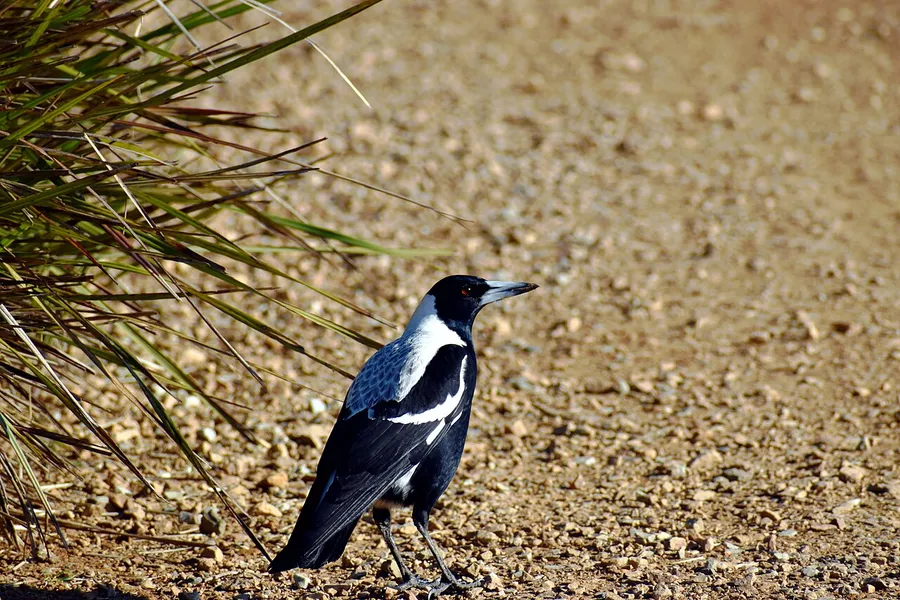

Start with shape and regional markings
An Australian Magpie is a sturdy black-and-white bird with a prominent wedge-shaped bill. Adult eyes are chestnut brown. Back patterns vary: white-backed and black-backed birds belong to the same species. Females often have more grey mottling.
Compare a local bird with photographs from its region before deciding that an unfamiliar back pattern means a different species. BirdLife's profile describes magpies across Australia; a single photograph cannot show all that variation.
Compare the Pied Butcherbird
A Pied Butcherbird also wears black and white, but has a hooked bill, a black hood and throat, and a broad white collar. Those features are more useful than colour alone. Young butcherbirds can be browner than adults, so an unfamiliar-looking bird deserves a second check.
If you cannot see the bill or head clearly, keep a note of the uncertainty. Avoid turning a distant impression into a confident species label.
Sources: Australian Museum: Pied Butcherbird
Trees, open ground and a familiar territory
Look for magpies where trees adjoin open ground: woodland edges, parks, gardens and playing fields. They search on foot for insects and larvae. Their territory supplies food, roosting places and nest sites, and resident groups defend it through the year.
A magpie repeatedly visiting a lawn may be using part of its normal feeding area. Its presence does not mean it needs a handout.
Sources: Australian Museum: Australian Magpie
Listen beyond the alarm call
Magpie calls include loud carolling, softer warbling, alarm calls and the repeated begging of young birds. Pairs or groups can sing together, and magpies can mimic other sounds. Carolling helps advertise or defend territory.
Listen for the context as well as the sound: is one bird feeding, are several calling together, or is a young bird following an adult? These are useful observations to record without trying to make the birds respond.
Sources: Australian Museum: Australian Magpie
Nesting and the birds that swoop
Magpies build a stick nest in a tree rather than nesting in a hollow. BirdLife gives August to November as the breeding period in its general profile; check local activity rather than treating those months as a precise calendar for every pair.
Professor Gisela Kaplan's explanation for the University of New England describes the female incubating while the male protects the nesting area. Some birds swoop when people approach. Her practical advice includes taking a detour around the nest and dismounting from a bicycle instead of riding faster. Give a nesting pair space; do not approach to test its response.
Sources: BirdLife Australia: Australian Magpie · University of New England: Gisela Kaplan on swooping magpies
Food and habitat around the home
BirdLife Australia advises against feeding wild birds mince, bread or other household scraps. A regular visitor still needs an appropriate natural diet. Making the garden useful for foraging is a better place to put your effort than establishing a feeding routine.
Keep useful existing vegetation and add locally native plants where resources are missing. A mix of groundcover, shrubs and trees supports a broader bird community than lawn and tall trees alone. Consider small birds' shelter as well as the space a magpie uses.
Sources: BirdLife Australia: A guide to feeding wild birds in Australia · BirdLife Australia: Creating a bird-friendly garden
Record what you can see
For an identification question, record the broad location, back and head markings, bill shape, habitat and behaviour. Mention whether the photograph shows an adult or an uncertain age rather than guessing a sex from one marking. Compare several features and say which ones were out of view. Never move closer to a nest just to complete a checklist.