
Magpie-lark or Australian Magpie?
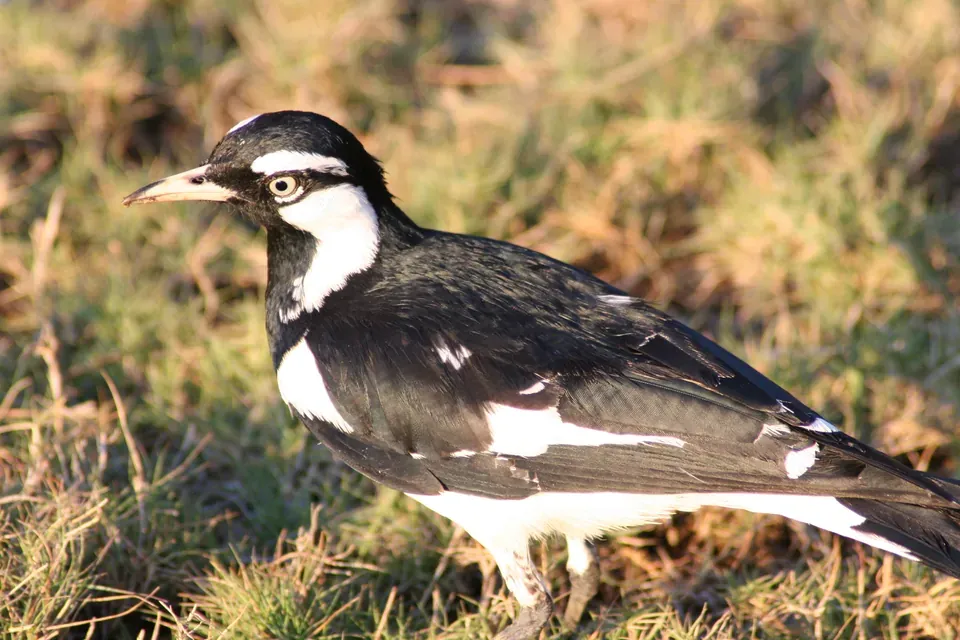
Start with the underside and bill. A Magpie-lark has a white belly and a relatively fine bill; an Australian Magpie is more robust, with a heavier wedge-shaped bill and dark underside. Size is helpful when the birds are together, but a lone photograph needs these structural and plumage clues.
A Magpie-lark is also called a Peewee or Mudlark. The familiar name does not make it a small magpie: it belongs to the monarch-flycatcher family. Record the visible features before choosing between similarly named birds. A rear view that hides the belly can leave the identification unfinished.
Scroll sideways, or focus the table and use arrow keys, to compare all columns.
| Observation | Magpie-lark | Australian Magpie |
|---|---|---|
| Belly | White | Black |
| Bill | Relatively thin and pale in adults | Heavier and wedge-shaped |
| Face | Adult patterns differ between sexes | Use the separate magpie guide; do not transfer this face rule. |
Sources: New Zealand Birds Online: Magpie-lark, identification and recordings · Ecolinc, Victorian Department of Education: Magpie-lark
Why a white throat does not prove adult female
Adult males have a white eyebrow and black chin-to-breast bib. Adult females have a white forehead and throat, bounded by a black band through the eye. Use the forehead, eyebrow and throat together rather than one pale patch.
Juveniles combine a black forehead and white eyebrow with a white chin. Their eyes and bill are initially dark, while adults have pale eyes and bills. A young bird can therefore share part of the female pattern without being an adult female. Shadow or a distant view can hide the useful details; leave age or sex unassigned when necessary.
Sources: New Zealand Birds Online: Magpie-lark, identification and recordings · Ecolinc, Victorian Department of Education: Magpie-lark
Listen for a pair, not necessarily one singer
The ringing call often sounds like the bird’s Peewee name. Partners may alternate notes in a duet, sometimes with wing movements, as part of their territorial behaviour. Two birds can make what seems to be one continuous phrase.
New Zealand Birds Online provides separate examples of an adult call, a pair and begging juveniles. Compare rhythm and the number of voices, not just loudness. Listen at home or quietly through headphones; do not play calls back towards birds or move closer to a nest to obtain a recording.
Sources: New Zealand Birds Online: Magpie-lark, identification and recordings
Water, open ground and the mud cup
Magpie-larks are widespread across mainland Australia in open country, including parks and roadsides, especially where water and trees are available. They are rare visitors to Tasmania. A school oval or park can supply foraging ground, while nearby trees supply perches and nesting places.
They walk over short vegetation and bare ground looking for invertebrates. Their nest is a distinctive cup made with mud and plant material. Both parents incubate and feed young, and dependent fledglings continue receiving food after leaving the nest. Ecolinc describes August–February breeding in its Victorian context, especially after rain; that is not a fixed national calendar.
Sources: Ecolinc, Victorian Department of Education: Magpie-lark · New Zealand Birds Online: Magpie-lark, identification and recordings
Make the next observation useful
From your existing position, note bill shape, belly colour and the complete face pattern. Add broad region, date and whether one or two birds were calling. A distant bird is a better reason to keep an honest partial record than to approach until it moves.
Keep pets away from young birds and nesting places. A visibly injured bird, collision victim or dependent youngster of uncertain status needs advice from a licensed rescue group or vet, not an identification experiment. Use the linked baby-bird guidance and rescue directory before attempting feeding, capture or relocation.
Sources: New Zealand Birds Online: Magpie-lark, identification and recordings · WIRES: Helping chicks