
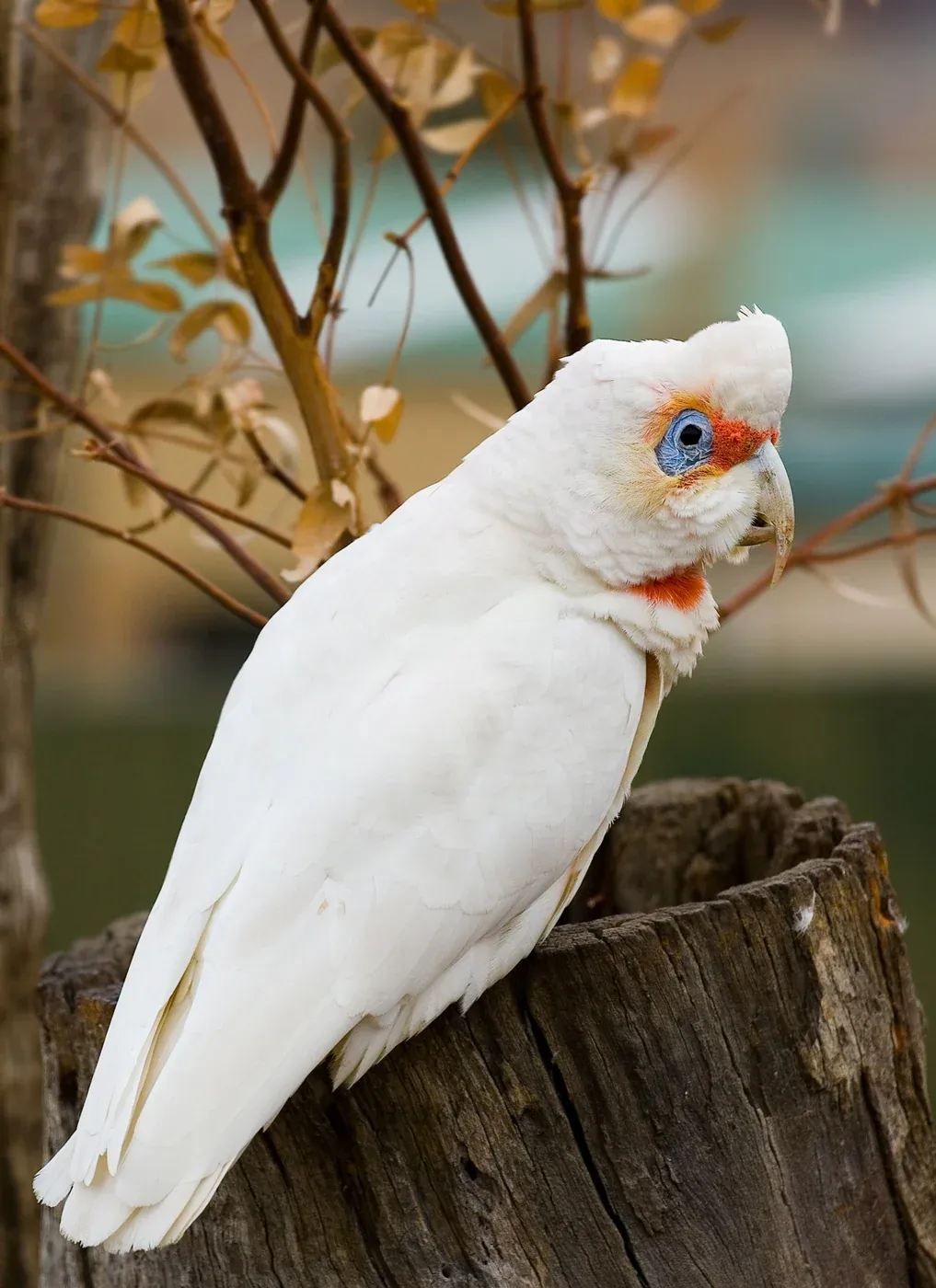
A long bill plus a red-orange crescent
The elongated upper bill is striking, but use it with the orange-red forehead and throat marks and crescent across the upper breast. The body is white, the crest short and the bare eye ring pale blue-grey. Yellow below the wing and tail is faint and shared with other white cockatoos.
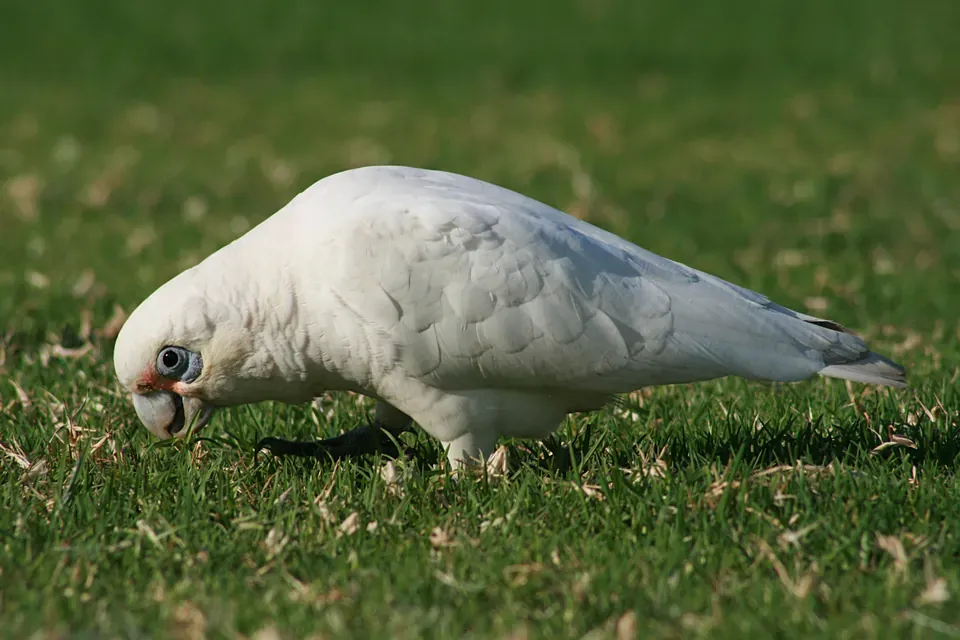
A Little Corella has a much shorter bill and lacks that clear upper-breast crescent. A Sulphur-crested Cockatoo instead has a dark bill and yellow crest. If the bill is hidden by grass or turned away, record a corella rather than treating an unseen feature as absent.

Sources: Australian Museum: Long-billed Corella · Australian Museum: Little Corella · South Australian Department for Environment and Water: Little corellas
Age and sex are separate questions
The Victorian strategy describes the sexes as externally alike. A bird with an especially conspicuous bill is not automatically a male, and a shorter-looking bill in a foreshortened photograph does not establish a youngster.
Treat a photograph as evidence of visible structure and plumage, not a birth record. Age or sex may remain unassessable even after the species is reasonably clear. If a bird is begging near an adult, describe the behaviour rather than assuming size alone establishes independence.
Sources: Victorian Government: Corella Strategy 2022–2032 · Australian Museum: Long-billed Corella · WIRES: Helping chicks
South-eastern origin does not mean every flock is native locally
The native range is in south-eastern Australia. Grassy woodland, pasture, crops and urban parks can provide foraging habitat. The WA Museum also documents an established introduced population around Perth and the Swan Coastal Plain. An Australian native species can therefore occur outside its natural regional range.
In south-west WA, distinguish this species from Western Corella, Cacatua pastinator. Both can have a long bill; names containing “western long-billed” and “eastern long-billed” need care. Use the WA Museum’s three-way comparison and local advice rather than assuming every long-billed white bird is Cacatua tenuirostris.
Sources: Australian Museum: Long-billed Corella · Western Australian Museum: Corellas · Victorian Government: Corella Strategy 2022–2032
Ground feeding, calls and seasonal groups
Flocks forage on the ground. Victoria’s strategy describes the use of grass corms and crops and explains how changing feeding opportunities bring birds into town landscapes. The long bill is a useful identification feature, but a single hole in turf cannot establish which animal made it.
The Museum describes a loud quavering two-part call as well as harsh screeches. Write down the rhythm and whether the calling bird was visible. A loud white flock may include more than one species; the sound should support a bill-and-face comparison rather than replace it. Do not play recordings at roosts or nests to make birds respond.
Sources: Australian Museum: Long-billed Corella · Victorian Government: Corella Strategy 2022–2032
Both parents need the hollow
Pairs use hollows in large old eucalypts, with occasional other cavities. Both parents prepare the site, incubate and feed young. This dependence on nesting cavities is different from the flock’s conspicuous use of open grass for feeding.
Watch repeated movements from a distance without approaching the entrance or trying to inspect the cavity. The seasonal aggregation of birds after breeding should not be confused with an overnight population increase. Local resource use and a longer series of observations are more informative than one crowded roost.
Sources: Australian Museum: Long-billed Corella · Victorian Government: Corella Strategy 2022–2032
A practical next observation
Note broad region, the full bill profile and whether a red-orange crescent is visible on the upper breast. In a mixed flock, follow one bird’s marks at a time instead of combining the face of one with the body of another.
Avoid handouts and keep pets away from young birds. For a grounded young parrot, visible injury or an entangled bird, seek a licensed rescue group or vet promptly and follow their direction. Regional pest classifications do not supply a safe capture or handling method.
Sources: WIRES: Let nature feed itself · WIRES: Helping chicks · Western Australian Museum: Corellas