
Which features separate these two night birds?
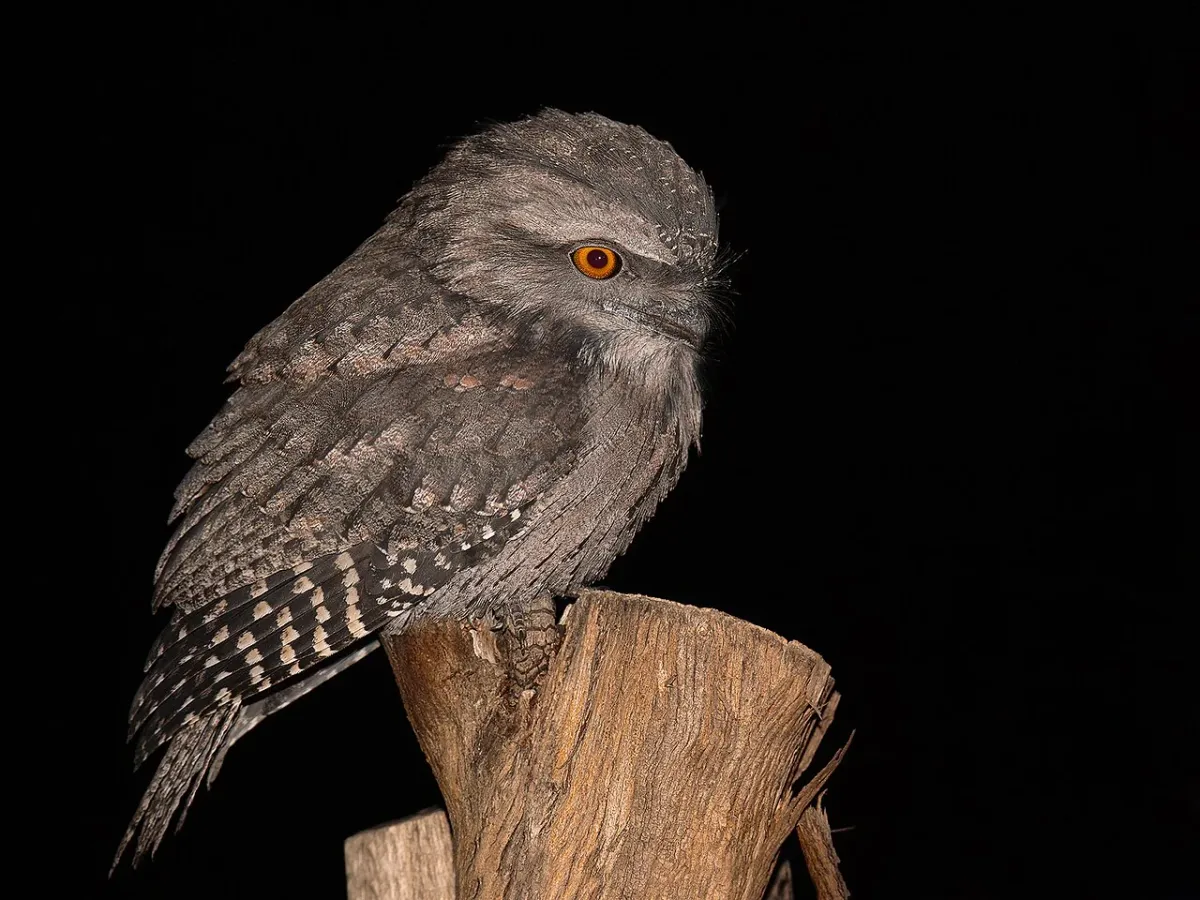
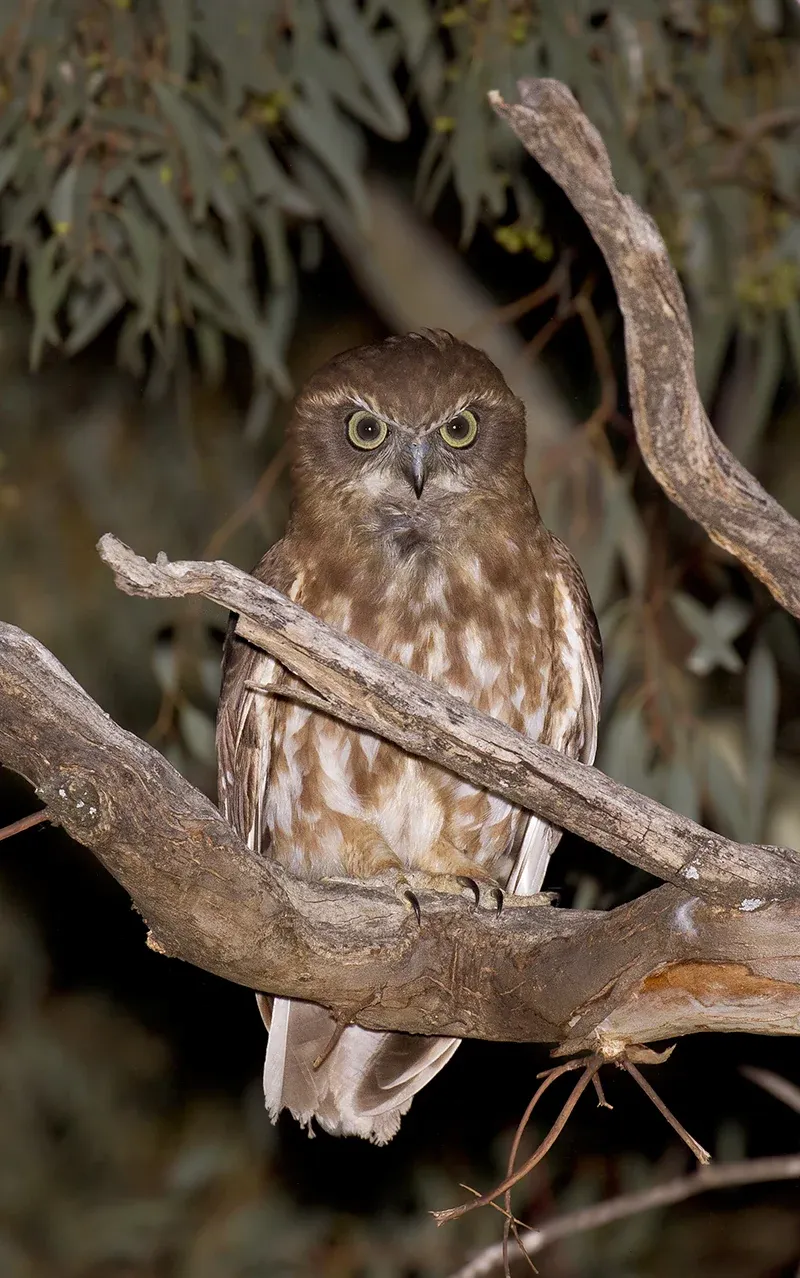
A Tawny Frogmouth is a frogmouth, not an owl. Its broad, heavy bill and streaked, bark-like plumage are useful starting points. An Australian Boobook has a rounder owl face with a conspicuous dark facial disc, a smaller-looking hooked bill and pale marks on brown plumage. Yellowish eyes alone fit both.
Compare several visible features from where you already are. A hidden foot or folded wing is not a reason to approach a roost. Frogmouths lack the powerful curved owl talons, but you do not need to inspect the feet to make a cautious comparison.
Scroll sideways, or focus the table and use arrow keys, to compare all columns.
| Feature | First comparison | Second comparison |
|---|---|---|
| Bill and face | Frogmouth: very broad bill; bark-like face pattern. | Boobook: owl facial disc and more compact hooked bill. |
| Plumage | Frogmouth: mottled grey or rufous colour forms. | Boobook: brown with pale spotting and streaking. |
| Familiar call | Frogmouth: low, repeated oom or ooo. | Boobook: repeated two-note boo-book. |
| Usual nest | Frogmouth: loose stick platform in a branch fork. | Boobook: tree hollow. |

Sources: Australian Museum: Tawny Frogmouth · Australian Museum: Australian Boobook, updated 4 November 2026
Colour is not a simple male–female switch
Tawny Frogmouths occur in grey and rufous or chestnut forms. The specialist ABSA account says rufous and chestnut birds are female, but females can also be grey. “Grey means male” therefore fails. Subtle cheek, throat and wing contrasts require a clear view and species-specific interpretation, not a colour impression from a dim photograph.
Young frogmouths have fluffy contour feathers and less distinct patterning, but begin acquiring more adult-like feathers soon after fledging. A fluffy outline can be a clue; it cannot establish an exact age or independence. Size also overlaps between sexes and varies geographically.
Boobook age clues are different: the Museum describes young Australian Boobooks with pale buff-white underparts and dark facial discs. Do not call a pale owl a young frogmouth simply because it looks fluffy.
Sources: Australian Bird Study Association: Tawny Frogmouth age and sex account (PDF) · Australian Museum: Australian Boobook, updated 4 November 2026
Use region and the current species name
Tawny Frogmouths occur across Australia, including Tasmania, in many wooded and settled habitats. South-eastern birds tend to be larger than northern birds. A large grey bird in the south and a smaller warm-coloured bird in the north need not represent different species.
This comparison’s owl is the Australian Boobook of mainland Australia. The Museum’s current account distinguishes the Tasmanian Boobook, Ninox leucopsis, and other island species. Older pages and image captions may say Southern Boobook. Keep the location with the name rather than extending the mainland comparison to every island owl.
Sources: Australian Museum: Tawny Frogmouth · BirdLife Australia: Tawny Frogmouth, including call recording · Australian Museum: Australian Boobook, updated 4 November 2026 · Australian Bird Study Association: Australian Boobook taxonomy account (PDF)
Calls and hunting tell different parts of the story
The frogmouth’s soft repeated oom contrasts with the boobook’s familiar paired notes. Both have other vocalisations, so one absent familiar sound does not exclude the bird. The linked BirdLife frogmouth player supplies a reference sound; the Museum describes the boobook call.
Frogmouths commonly hunt invertebrates, dropping from a perch to the ground, and also take small vertebrates. Boobooks hunt small animals by watching and listening from perches. A bird’s still daytime posture is not evidence that it has been abandoned or needs feeding. Keep a roost quiet and view it without flash, playback or attempts to make it move.
Sources: BirdLife Australia: Tawny Frogmouth, including call recording · Australian Museum: Australian Boobook, updated 4 November 2026 · BirdLife Australia: Ethical Birdwatching Guidelines
Breeding, branchlings and when to ask for help
Tawny Frogmouths build a loose stick platform on a branch. Both sexes incubate; the male sits by day and both share nights. BirdLife describes a broad August–January period in temperate southern Australia and rain-responsive breeding in arid places. That is a regional summary, not a national calendar.
Australian Boobooks normally use a tree hollow, with the female incubating and adults feeding young. Nest type is a useful life-history distinction, not an invitation to inspect a hollow or platform.
A young bird’s position alone is insufficient for a rescue decision. Keep people and pets back; seek licensed advice if there is injury, a known collision, or uncertainty about a dependent youngster. Follow the baby-bird guide’s species exceptions rather than moving a young bird onto a branch or applying one waiting time to every species.
Sources: BirdLife Australia: Tawny Frogmouth, including call recording · Australian Museum: Australian Boobook, updated 4 November 2026 · WIRES: Helping chicks · BirdLife Australia: Ethical Birdwatching Guidelines