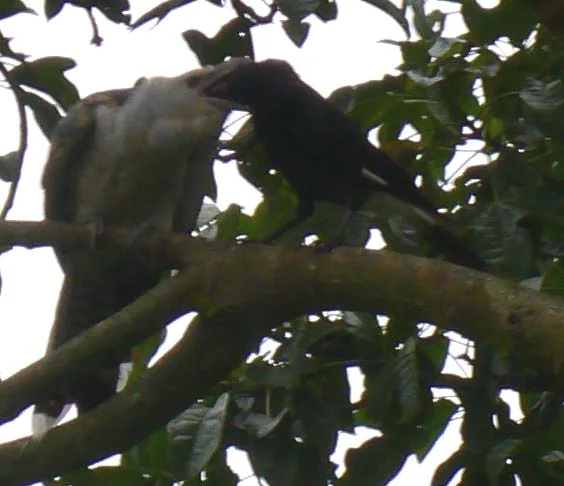
A large young bird begging from a much smaller carer can look like a family mismatch. With some Australian cuckoos, that is exactly the breeding relationship: the cuckoo developed in another species’ nest and continues receiving care from its hosts.
Brood parasitism means placing eggs in another bird’s nest and relying on that bird to incubate or raise the young. It can impose severe costs on the hosts. It is also a natural life history, not a mistake that a passer-by should correct by removing the chick.
Start with the cuckoo species
The Channel-billed Cuckoo uses hosts including Australian Magpies, Pied Currawongs and members of the crow family. The Australian Museum describes young Channel-billed Cuckoos competing strongly for food rather than ejecting host eggs and chicks themselves. The laying female can damage host eggs.
That differs from the nest-mate eviction associated with several small bronze-cuckoos. In that case, the young cuckoo itself removes eggs or chicks. A general story about a tiny cuckoo pushing eggs out cannot simply be transferred to every large cuckoo youngster seen in a garden.
The Channel-billed Cuckoo is a breeding migrant to northern and eastern Australia, generally arriving from New Guinea and Indonesia between August and October and departing in late summer or early autumn. Those broad movements provide seasonal context, rather than an exact arrival date for every locality.
There is another important exception to the familiar cuckoo story: Pheasant Coucals build their own nests and raise their own young. The name cuckoo does not establish parasitic breeding on its own.
For a separate feeding example, watch a young koel being fed by a Magpie-lark, filmed by Aviceda at Gympie, Queensland, in March 1997. This opens the credited source video; it shows a different cuckoo–host pairing from the Channel-billed Cuckoo and Pied Currawong pictured above.
Adult cuckoos can remove young too
Chick eviction and adult nest-raiding are different behaviours. Guppy and colleagues’ 2017 camera study, covering three breeding seasons near Moruya, NSW, recorded adult Fan-tailed Cuckoos taking host eggs and young. A cuckoo does not have to hatch in a nest to cause its brood to fail.
The authors discuss nest spoiling, or “farming”: removing a brood after the suitable laying stage has passed may induce the hosts to nest again, creating another laying opportunity. That is a proposed reproductive benefit, rather than evidence that these Australian cuckoos were punishing egg rejection. Brood destruction means the loss of eggs or young; it need not mean tearing the nest structure apart.
What about the cuckoo “mafia” story?
A 1995 experiment in Spain found more nest predation after researchers removed Great Spotted Cuckoo eggs from European Magpie nests than when eggs remained. Observations and marks on model eggs implicated adult cuckoos. These are European Magpies, not Australian Magpies.
The findings support the mafia hypothesis, but the study could not distinguish inducing another clutch from retaliation. They do not prove conscious revenge or establish that Australian cuckoos generally destroy a brood whenever a host ejects their egg. An empty nest alone cannot identify the culprit or its motive.
A host has more than one chance to resist
Preventing an adult cuckoo from laying, rejecting an egg and rejecting a chick are distinct defences. Success or failure at one stage changes the importance of later stages. Recognising a problem after hatching is late in the breeding attempt, but it can still matter when earlier defences have failed.
Langmore and Kilner’s account of Horsfield’s Bronze-Cuckoos and Superb Fairy-wrens describes this as a defence portfolio. Fairy-wrens rely heavily on chick rejection in this system because the cuckoos can get through earlier barriers.
An evolutionary arms race means that host defences and parasite countermeasures can impose selection on each other over generations. It does not mean a cuckoo chick plans a deception or that a host’s response is infallible.
Which Australian birds rejected unfamiliar eggs?
Langmore and colleagues’ 2005 comparison tested conspicuous blue eggs sized to match each host’s eggs. Most Australian trials took place around Canberra during 1999–2002. These selected results give useful examples:
Scroll sideways, or focus the table and use arrow keys, to compare all columns.
| Australian species | Trials scored as rejection | Trials completed |
|---|---|---|
| Grey Fantail | 8 | 8 |
| Willie Wagtail | 6 | 6 |
| Rufous Whistler | 6 | 6 |
| Silvereye | 7 | 10 |
| Red Wattlebird | 3 | 7 |
The five-day scoring included desertion and ejection or damage, rather than just neatly removing the foreign egg. Small samples and deliberately poor colour matches limit the comparison. The figures describe those tests, rather than a bird’s chance of defeating a naturally laid, well-matched cuckoo egg. Fairy-wrens and several thornbills often accepted the test eggs.
Detecting a difference, removing an egg and saving a brood are separate outcomes. An abandoned nest may end that breeding attempt even when the cuckoo is also defeated.
Egg shape and an unusual fairy-wren observation
Fairy-wrens’ frequent acceptance of odd-coloured eggs leaves room for other cues. Taylor and Langmore’s 2020 study, summarised in its university abstract, found that relatively short, round Horsfield’s Bronze-Cuckoo eggs were more likely to be abandoned by Superb Fairy-wrens than long, narrow eggs. Egg shape mattered in that study; it does not establish a simple rule that any larger egg will be rejected.
There is also a documented ejection. Turner and colleagues’ 2022 paper reports footage from October 2019 in Canberra’s Australian National Botanic Gardens. A female Superb Fairy-wren removed an egg that the researchers identified as a Fan-tailed Cuckoo’s from its size and the cuckoo’s preceding presence. Laying itself was not filmed. This single observation establishes an important possibility, while providing no population-wide rejection rate.
Resembling the right chick can matter
A study of visual mimicry in three bronze-cuckoo species found that cuckoo nestlings resembled their own hosts more closely than other host species. Accuracy varied with the diversity of hosts used.
The key comparison is therefore not simply “does this look like a generic baby bird?” A parasite using one set of hosts faces a different appearance problem from a parasite using another. And the relevant receiver is the host bird, whose visual perception cannot be reduced to what a person notices in a photograph.
This helps explain why recognising an obvious difference between an older cuckoo and its carer does not tell us which cues were available at hatching. Appearance and the opportunities for rejection change during development.
Gerygones can use a visual recognition template
In a 2018 study of Little Bronze-Cuckoos and Large-billed Gerygones near Cairns, researchers found evidence that hosts used at least one direct visual trait: the number of down-feathers on newly hatched chicks. Experimental changes to that down affected rejection, including mistaken rejection of altered host chicks. Hosts could remove a cuckoo very soon after hatching, while typically accepting cuckoo eggs.
The experiment also varied opportunities to encounter an adult cuckoo at laying. Evidence about that contextual cue depended on which dataset was analysed. The clearest result concerned chick appearance; it does not supply a rejection percentage that can be ranked against the blue-egg trials above.
The authors argued that the recognition template must be largely innate, given the risks of learning the wrong first brood as the standard. This is an interpretation of the tested system, rather than a universal rule or a way for visitors to decide which chick belongs.
Accepting an egg can also have a benefit
Noh and colleagues’ 2023 university abstract adds a further explanation for Large-billed Gerygones. When several cuckoos lay in one nest, retaining a cuckoo egg can reduce the chance that a later cuckoo removes a host egg. The researchers found egg acceptance could benefit host-egg survival, alongside flexibility when clutches contained only cuckoo eggs. Acceptance can therefore depend on context, while chick rejection supplies a later defence.
Experience can change a fairy-wren’s response
A 2009 study’s university abstract describes flexible chick-rejection rules in Superb Fairy-wrens. Experienced females were relatively more likely than inexperienced females to abandon a lone Horsfield’s Bronze-Cuckoo chick while accepting a lone fairy-wren chick. Responses also changed with the presence of adult cuckoos in the population.
That is a comparison within one host species. Breeding experience and local risk can therefore matter alongside species identity. The costs include accidentally abandoning a host’s own youngster; a stronger response is not automatically a better decision in every nest.
Fairy-wrens supply a vocal comparison
Superb Fairy-wrens offer another route. Colombelli-Négrel and colleagues’ 2012 research found that females called during incubation and that their nestlings’ begging calls later contained elements of those calls. Cross-fostering results linked the strongest similarity to the incubating foster mother rather than simply to genetic parentage.
In playback tests, adults responded more to the calls of young hatched in their own nests than to other wren or cuckoo nestlings. The authors described this as an embryonically learned vocal password.
Password is a useful analogy for a learned acoustic cue. It should not be turned into a guarantee that every mother rejects every cuckoo, or a claim that the nestlings consciously memorise a word. The experiment concerns specific call similarities and adult responses.
Mimicry need not last throughout childhood
Research on Little Bronze-Cuckoos and Large-billed Gerygones in 2021 found the cuckoo’s begging calls most similar to the host’s shortly after hatching, when rejection typically occurs. Similarity decreased as the cuckoo grew.
The study found no evidence that the cuckoo calls were plastic—flexibly adjusted to match different hosts—in the tested setting. Vocal resemblance and the ability to learn a different host’s call are separate claims. A useful explanation must preserve that distinction rather than describing every mimic as a flexible impersonator.
Observe the relationship without testing the nest
If you happen to see a feeding interaction from a path or garden, note the visible traits of both birds, which bird received food, the date and broad region. An existing distant photograph may help compare the magpie and currawong hosts. Do not follow the carers to a nest, move chicks or eggs, play begging calls or provoke adults to test these findings.
A feeding interaction alone cannot establish the whole breeding history or tell you whether either bird is injured. A cuckoo youngster can still need licensed help after a collision, pet encounter or other harm. Use the baby-bird guidance and rescue directory for a concerning animal; do not feed, handle or attempt to correct its host relationship yourself.
Listen & compare
Hear two adult cuckoo calls
These recordings are adult-call examples. The chick-recognition studies above concern nestling cues. Listen quietly indoors; BirdLife Australia advises against recreational call playback around wild birds.
Fan-tailed Cuckoo
A Fan-tailed Cuckoo call.
Source dated 8 May 2010 · About 12 seconds
Recording: Wardie44 · Public domain. MP3 transcode supplied by Wikimedia Commons.
Download the recordingHorsfield's Bronze-Cuckoo
An adult Horsfield's Bronze-Cuckoo call.
November 2008, Samsonvale, south-east Queensland · About 15 seconds
Recording: Aviceda · CC BY-SA 3.0. Original Ogg recording, unchanged.
Download the recording