A cloud of green and yellow parrots can make inland Australia look suddenly full of Budgerigars. The same place may have held only a small flock on an earlier visit. This change is part of the wild bird’s life: Budgerigars move as food and water opportunities change.
Calling that movement nomadic is more useful than imagining a fixed migration timetable. A particular month does not guarantee a flock at a particular waterhole.
Rain matters through the food it supports
Budgerigars eat mainly seeds of native grasses and other plants, often taking them from the ground. BirdLife Australia associates exceptionally large flocks with seasons of plentiful rain and food. Smaller gatherings are much more usual.
The connection is ecological rather than a promise that birds arrive immediately after every shower. When watching a site, record the available seed, recent conditions and what the birds actually do. Rainfall alone does not tell you how many Budgerigars a landscape will support.
Birds SA describes flocks moving over the ground together while individual birds search for seeds. A flock can therefore be a feeding group, not simply a mass of birds travelling past.
The seed supply changes across places and seasons
Wyndham’s 1980 field study in inland mid-eastern Australia found that the diet differed between two settings. On Mitchell grass plains, Mitchell grass seeds dominated. Farther inland, birds used a changing mixture that included saltbush, grasses and Boerhavia. The principal foods differed between the hot months of 1973–74, the following winter and spring.
This explains why “seed-eater” is not a complete description of the bird’s requirements. The plants producing accessible seed differ, and a landscape can offer several opportunities over a season. The study found similar diets in males and females and in adults and young. It did not find evidence that breeding required insects or soft, unripe seed. That is evidence from particular wild populations, not a test establishing a nutritionally complete captive seed mix.
Rainfall is therefore best considered alongside vegetation and food already present. A shower, new plant growth and mature seed are different stages; an observer should not assume that a newly wet patch already provides all the food needed for breeding.
Food and drinking places are different resources
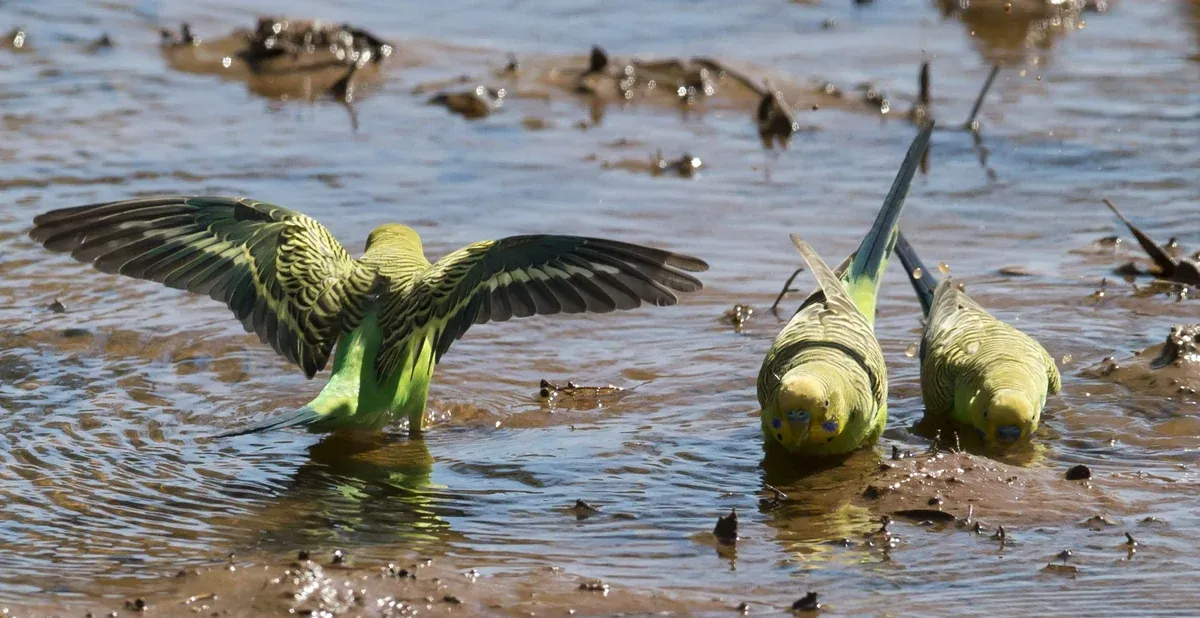
Dry seeds provide little moisture. BirdLife describes regular visits to fresh water, sometimes alongside pigeons, finches and other parrots. A place to drink can concentrate birds whose feeding grounds are spread more widely.
This distinction helps interpret a spectacular sighting. A large gathering at water is not a census of all birds breeding nearby, and its size does not establish a long-term population trend. For a useful record, note whether birds are arriving to drink, feeding on the ground or leaving in a consistent direction.
Daily timing varies too. The national profiles emphasise morning feeding and drinking; Birds SA also describes late-day feeding and midday drinking in hot conditions. Avoid turning one observation into a rule that applies everywhere.
Breeding can respond to conditions
The Australian Museum describes nesting in bare tree cavities and breeding when conditions are suitable, with several broods possible. This is an opportunistic response rather than a requirement to breed in every month.
Birds SA gives August to January as a usual season in its regional account, while noting that good rain can extend or renew breeding. Those accounts fit together when their scales are kept clear: a regional seasonal tendency is not a continent-wide deadline.
An occupied hollow also deserves space. Watch from a position that leaves the adults’ route clear rather than approaching to inspect eggs or young.
Nomadic does not mean without seasonal patterns
Wyndham’s 1983 analysis described different seasonal tendencies across Australia. In the far south, birds commonly arrived in spring, bred and left during summer. Across middle latitudes, the main breeding period shifted from spring–summer farther south towards summer–autumn farther north. In northern Australia, breeding was concentrated earlier in the dry season, during autumn and winter; birds could be scarce during the wet season itself.
These broad patterns challenge the idea that Budgerigars simply appear wherever rain is falling that day. They also show why nomadic movement and seasonal regularity can coexist. This is a historical regional analysis, not a current prediction for any particular waterhole. Local rain, seed and water observations remain necessary.
Recognise the wild bird
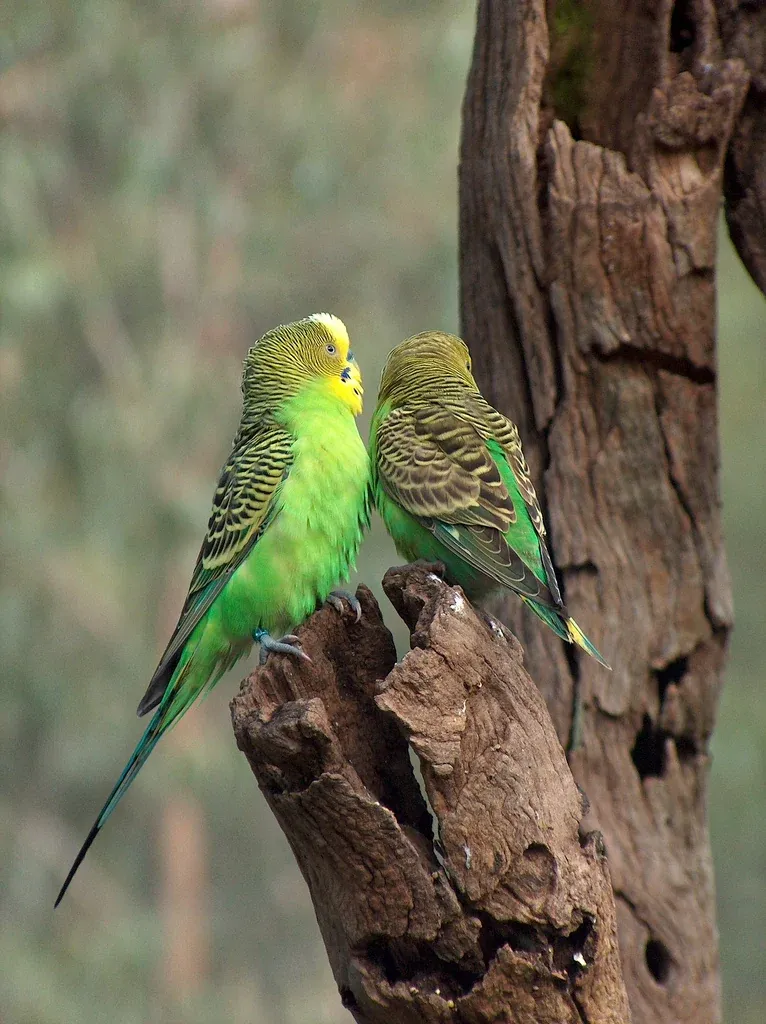
Wild Budgerigars have green and yellow plumage with dark barring and a long, pointed tail. The blue, white and other colours familiar in pet birds are captive-bred variants; they are not the normal colour range of a wild inland flock.
Age and sex require a closer distinction. ABSA’s wild-bird account describes a young bird’s dark iris and barred forehead, compared with the pale iris and clear yellow forehead of adults. In adults, the male’s cere—the fleshy area around the nostrils—is dark blue. A female’s can change from pale blue outside breeding to pinkish-brown when breeding. Young birds have a paler, purplish cere, so applying the adult colour rule too early can mislead. Judge several features together, and do not extrapolate these wild-type descriptions to every captive colour mutation.
For your next sighting, record the location, approximate flock size, habitat and activity. A modest group feeding naturally can tell you more about how the species uses a place than a photograph of a vast flock without that context.
Illustrated explanation
Green and yellow in the wild
Illustration sources checked .


Sources: · Read the explanation in context