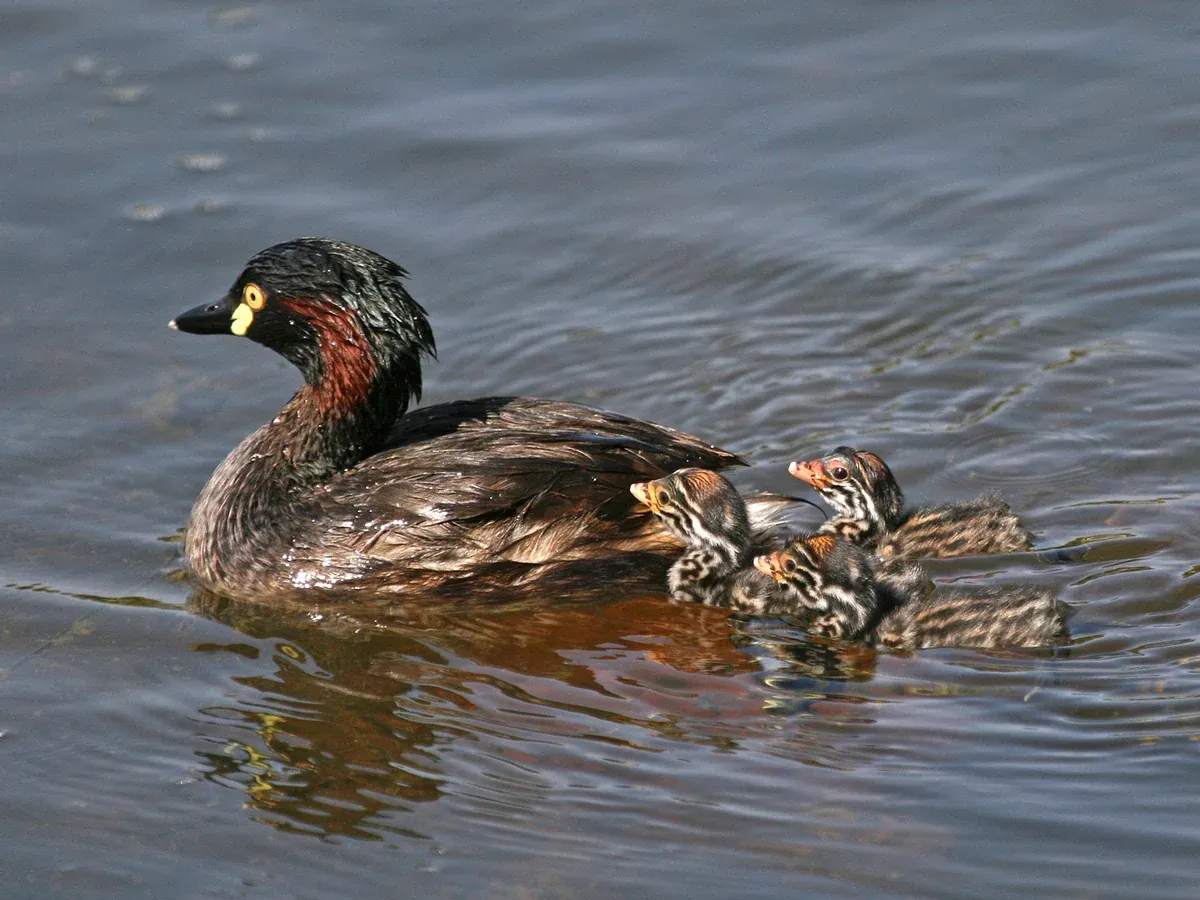
A small waterbird vanishes beneath a farm dam, then surfaces with a striped youngster nearby. It may be an Australasian Grebe, a diving bird whose family life is closely tied to a floating nest and continuing parental care.
The chicks can swim very early. That ability does not make them independent or mean that a chick beside an adult needs rescuing.
A floating nest is still anchored
The Australian Museum describes a mound of water plants normally attached to a submerged branch or reed. It floats, but is not intended to drift freely across the wetland.
This is different from a nest on a dry bank: the nesting structure sits among the wetland’s vegetation and water. From a viewing point, look for an adult returning to a low platform rather than assuming every mound is a nest. Do not move plants aside to find out.
Both parents care for the striped, downy young. The Museum gives different usual breeding periods for southern and northern Australia, so a southern spring observation should not be turned into a national nesting calendar.
Swimming is not the end of parental care
BirdLife describes chicks following their parents for weeks and sometimes resting on an adult’s back. A chick tucked into the feathers is taking a lift, not growing out of the adult’s body.
Back carriage and swimming can occur within the same family’s day. Count carefully: young hidden against an adult may not be visible from every angle. Equally, a brief gap between an adult and a swimming youngster is not evidence that the parent has abandoned it.
An observer’s presence matters. Grebes often dive when approached. If your arrival repeatedly makes an adult disappear, increase your distance rather than following along the bank for a closer photograph.
What does a back ride provide?
A parent’s back is both transport and a place to brood. A 2024 review by O’Leathlobhair and colleagues explains how carrying young allows a grebe family to move while the adult continues sheltering the chicks. It also considers reduced exposure to aquatic predators as a possible benefit. These explanations concern grebes and other waterbirds broadly; they are not a measured survival advantage for Australasian Grebe chicks in an Australian dam.
The distinction matters when watching a family. A swimming chick has movement skills, but may still need warmth, protection and food from an adult. A back ride does not demonstrate that the chick is unable to swim. Nor does an adult with no visible passengers necessarily have no chicks: some may be swimming, while others are concealed among its feathers.
The same adult can look quite different
The Museum describes a darker breeding head with a chestnut stripe on the side of the face and neck. Outside breeding condition, the head is browner and the underparts much paler. Both sexes change appearance.
Use several features together: small size, compact shape, diving behaviour, head pattern and the pale patch at the bill’s base. A brownish bird and a strongly patterned bird do not automatically represent two species or a male and female.
Compare the other small grebe
Non-breeding Hoary-headed Grebes can be confusingly similar. Birds SA describes their dark cap extending below the eyes and the absence of the Australasian Grebe’s bare patch at the bill’s base. Hoary-headeds also often gather on larger, more open water, including brackish water. Habitat is a supporting clue, not a substitute for seeing the head. If the bill-base patch and cap boundary are hidden, leave the identification open rather than relying on size alone.
Why do grebes eat feathers?
These grebes catch small fish and aquatic insects, principally underwater, with some prey taken at the surface. BirdLife also records adults eating feathers and feeding them to chicks.
Its explanation is qualified: the feathers are thought to help protect the digestive tract from sharp fish bones. The behaviour is observed; that proposed function should not be presented as a settled explanation for every swallowed feather.
Research offers more than one explanation. Piersma and van Eerden’s 1989 study examined stomach contents from 407 Great Crested Grebes at Lake IJsselmeer in the Netherlands. Feather numbers differed with moult and the fish being eaten. The authors proposed that feathers provide material for a pellet when prey leaves little indigestible residue; casting pellets might also help remove gastric parasites. This was a proposed function inferred from stomach contents, not an experiment proving that feathers prevent injury.
Jehl’s 2017 paper, developed from work on Eared Grebes, argued for a different emphasis. A feather mass retains food for chemical digestion, while feathers near the stomach’s outlet help filter material before it reaches the intestine. In that interpretation, ejecting pellets is a necessary way to discard accumulated material, rather than the original reason for swallowing feathers.
Those studies help explain why “padding against fish bones” is incomplete: many grebes also eat hard-bodied invertebrates. They do not establish precisely how each function contributes in Australasian Grebes. The useful conclusion is that feather ingestion is part of a specialised digestive system, not evidence that the birds mistake feathers for fish.
Watch a family from the existing path and note dives, feeding, back rides and changes in adult plumage. Those ordinary activities are useful clues to a grebe’s life without approaching its nest or interrupting its care of the young.
Illustrated explanation
Swimming close to a parent
Illustration sources checked .

Sources: · Read the explanation in context