A small bird flashes a reddish rump, fans its tail and disappears into the shady part of a garden. If it is a Rufous Fantail, the visit may be a short stop during seasonal movement rather than the start of a permanent garden territory.
The distinction becomes clearer when a garden sighting is placed beside the species’ forest habitat and regional calendar.
Look below the canopy
BirdLife Australia describes Rufous Fantails using dense, shady vegetation in rainforest and moist forest, often close to the ground. They make short flights among foliage and branches while pursuing insects.
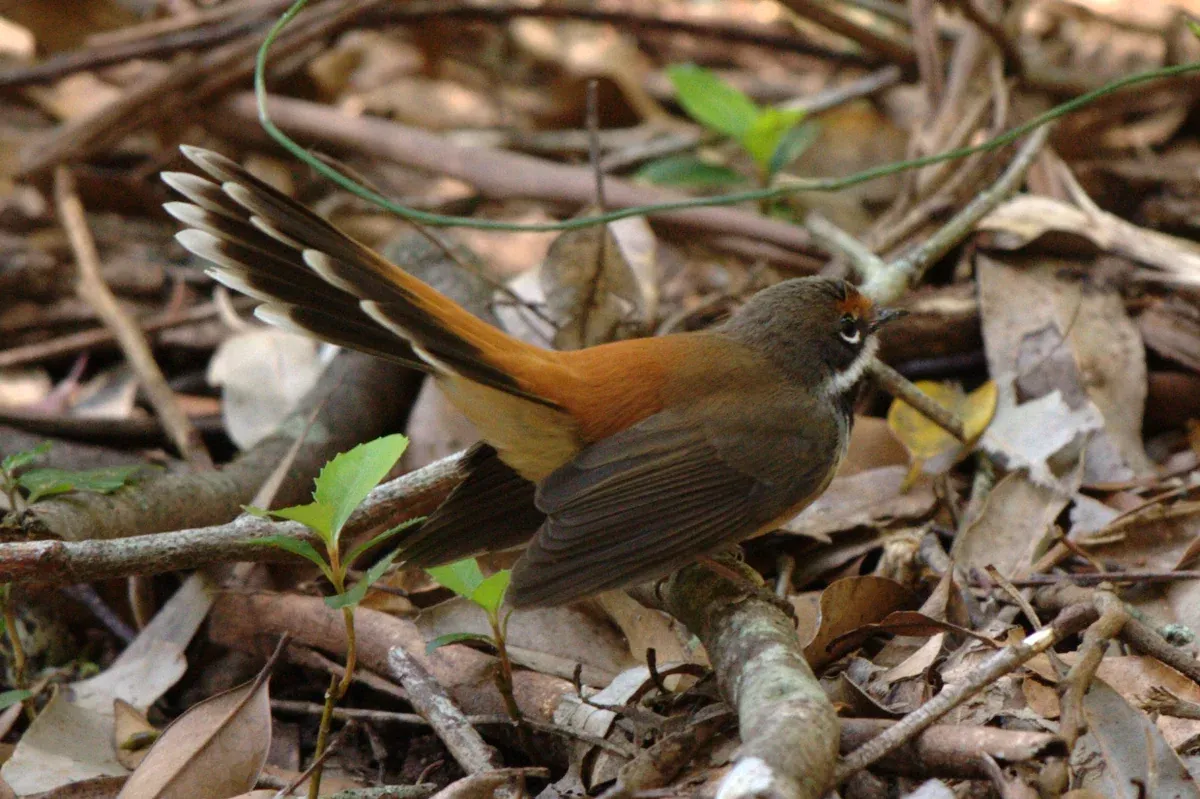
The reddish-brown rump and eyebrow, fanned tail and patterned breast are useful features to examine together. Young birds are duller and have less distinct breast markings, so one blurred patch of colour should not carry the whole identification.
The activity also matters: record what the bird actually does rather than labelling every movement a display. A short sally from a perch may be part of feeding.
A dull young bird is not automatically female
ABSA’s ageing account describes young Rufous Fantails as duller and browner, with less distinct facial markings and diffuse dark mottling across the upper breast. A pale lower bill and orange-yellow gape can also help when naturally visible. Older immature birds can already resemble adults while retaining juvenile wing and tail feathers.
The sexes do not have a dependable plumage difference. A less colourful bird should therefore not be labelled female merely because it lacks a strong adult pattern. Feather wear, age, lighting and the angle of the view all need consideration.
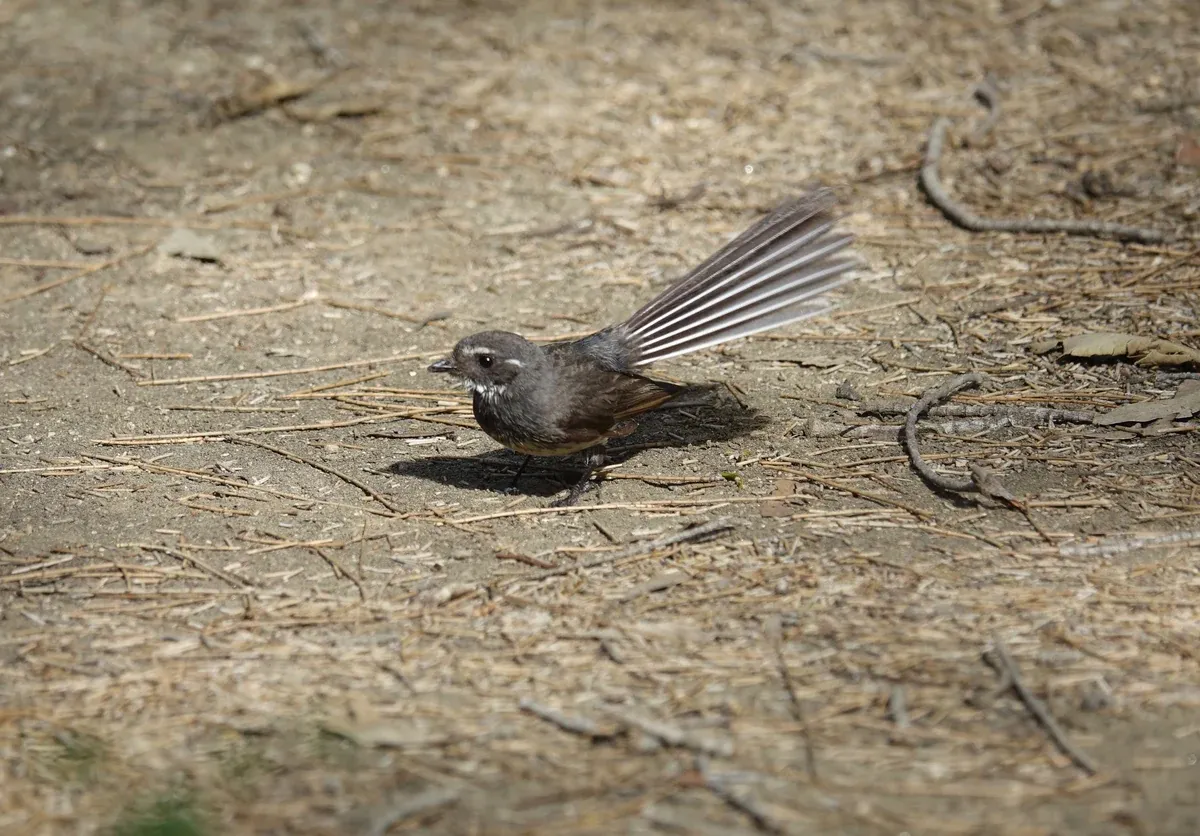
Grey Fantails share the restless flight and fanned tail, but their grey upperparts, white eyebrow and pale throat differ from the Rufous Fantail’s warm forehead, rump and tail base. A Grey Fantail can have a creamy-buff belly: warm colour underneath alone is not the same as a rufous rump. Try to see where the colour sits on the bird before deciding.
A Canberra garden is one particular setting
Canberra Birds describes the species as a summer visitor to the region’s higher forested ranges. In suburbs, birds are commonly encountered briefly while travelling to or from those areas.
Its garden account notes conspicuous November and March peaks. These are regional observations, not dates on which every Rufous Fantail in Australia begins or ends migration.
A bird visiting a Canberra garden in spring may therefore fit a passage pattern without showing that the garden is its breeding destination. Conversely, one unrecorded week does not prove that the species has vanished from all nearby forest.
Avoid turning an old survey trend or a local reporting rate into a newly measured national population change.
Northward and downhill are different movements
BirdLife’s Birdata migration explanation describes Rufous Fantails leaving south-eastern Australia in autumn. Some stop in northern Queensland; others reach Papua New Guinea.
It also includes altitudinal movement among some populations. Travelling from a higher forest to lower country is a different change from making a long northward journey, even when both occur in response to seasonal conditions.
Those examples are a reason to keep locality with the observation. They do not establish that every Australian bird makes the same trip or that a northern sighting can be interpreted using a Canberra timetable.
What a long-running banding study adds
Alan Leishman’s study near Campbelltown, south-west of Sydney, followed a Spotted Gum forest from December 1973 to July 1994. Across 144 banding visits, 64 Rufous Fantails were marked; only one was recaptured. The paper classified them as migrants, with captures concentrated in the warmer part of the year. By contrast, several resident species were repeatedly recaptured across seasons.
That comparison is more informative than simply noticing that a bird has disappeared. However, low recapture is not a direct measure of survival or proof that each bird continued to Papua New Guinea. Sampling effort varied, and small mist nets sample particular heights and habitats. The study provides evidence of seasonal use of one forest, not a map of every individual’s journey.
For a garden observer, the useful lesson is to combine dates, repeated visits and habitat with identification. A brief migrant visit can be valuable use of a patch even when no bird remains to nest there.
Make the record useful without holding the bird up
From an existing path or garden viewpoint, note the date, general locality, vegetation and feeding behaviour. A sequence of brief visits over several days is more informative when recorded as separate observations rather than assumed to be one resident individual.
Do not use playback, handouts or pursuit through dense cover to prolong the encounter. If the bird goes back into the understorey, let it go.
Keeping suitable vegetation matters beyond the few minutes when a bird is visible. A passing visitor can reveal a connection between gardens, lowland cover and the wetter forest it uses elsewhere.
Illustrated explanation
Compare the base of the tail
Illustration sources checked .


Sources: · Read the explanation in context