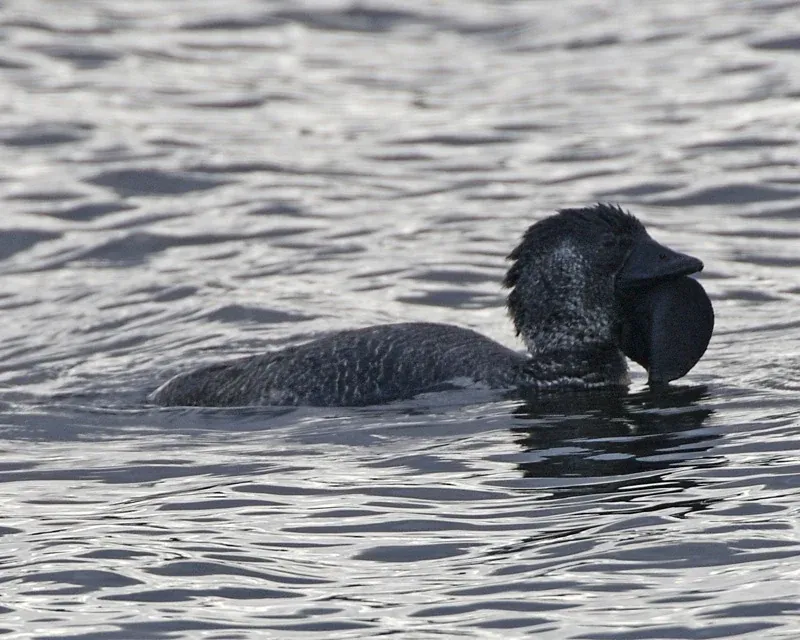
A bulky dark duck sits low in deep water, then raises its stiff tail and sends splashes across the surface. A large flap below the bill makes an adult male Musk Duck distinctive, but the flap is only one part of its courtship display.
Watching the sequence reveals more than treating the lobe as a strange object attached to an otherwise ordinary duck.
A lobe is normal anatomy
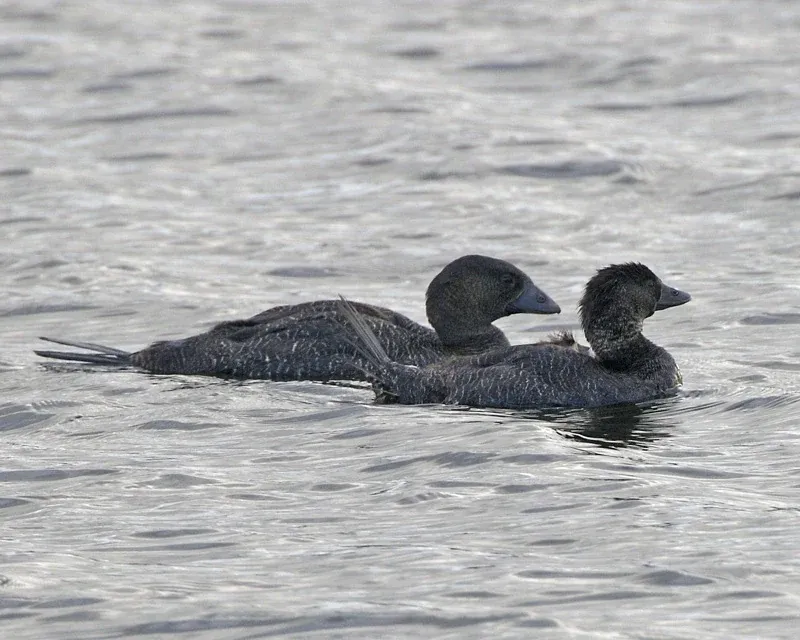
The Australian Museum describes a large skin lobe hanging below the adult male’s bill. Females are smaller and have a much reduced lobe that can be difficult to see. Young birds resemble females and can have a dull yellow bill tip without a visible lobe.
“No obvious flap” is therefore not a complete identification rule. Age, sex and viewing angle matter. Nor should the male’s large lobe be mistaken for food stuck to its face or an injury needing intervention.
Both sexes have dark, finely patterned plumage. A comparison that uses the whole bird is more reliable than one feature seen briefly through reeds.
The display has movement and sound
Birds SA describes the tail held upright, the neck bent to show the lobe, vigorous foot kicks and splashing, sometimes with a whistle. Its account also describes males displaying to females and conflict among rival males.
Observe which action comes first and whether the bird repeats a sequence. A splash, a body movement and a vocal sound are different components; seeing them together does not demonstrate that the lobe mechanically produces every sound.
These are natural displays, not an invitation to play recordings or approach until a bird reacts. If it stops feeding or changes position because you move closer, increase the distance.
Read the posture as a sequence
Fullagar and Carbonell’s 1986 study used film and observations of captive birds at Slimbridge in England and Serendip in Victoria. It distinguished three familiar components:
Scroll sideways, or focus the table and use arrow keys, to compare all columns.
| Component | What to watch for |
|---|---|
| Paddle-kick | Feet kick water sideways and backwards; the bird may move forwards rapidly. |
| Plonk-kick | The spread tail rises towards vertical; the bird is more nearly stationary or turns slowly. |
| Whistle-kick | The tail is pressed farther over the back, the neck is held low and the kick accompanies the characteristic call. |
The lobe could change from slack to firm within a display. This immediate change in presentation is separate from the longer-term size changes measured in the seasonal study below. A still photograph can capture only one posture.
The components did not always follow a simple uninterrupted ladder. The researchers recorded reversals and repeated sequences. It is more useful to note the tail, movement, kick and sound together than to label every splash from its loudness.
Eastern and western birds do not sound identical
McCracken and colleagues analysed 75 advertising displays at ten localities in South Australia, Victoria and Western Australia, publishing their work in 2002. Vocal patterns differed between the southeastern and southwestern populations; the western repertoire included calls described as poing-kicks. The number 75 refers to displays, not necessarily 75 individual males.
Captive and immature birds also gave clues that social experience contributes to developing the adult calls. The authors proposed learning, practice or social imprinting; their regional comparison was not an experiment separating those processes.
Consequently, a recording from one side of the continent need not sound exactly like a bird on the other. Nor does showing the lobe establish which part of the sound comes from the voice and which from water struck by the feet. Keep the recording’s location with any sound identification.
Does the lobe change through the year?
Cowling and Guay investigated that question in a study published in 2011. They photographed one captive male each month over 16 months and measured the visible lobe area.
Its largest and smallest measurements differed by almost threefold. That is evidence of substantial variation in the animal studied, not a universal ratio for all wild males or a way to assign the month from any photograph.
The study measured area from photographs. It did not establish that a larger-looking lobe in a casual sighting means greater health, dominance or mating success. Those are separate questions requiring their own evidence.
A diving duck is not stranded because it avoids the bank
The Museum describes legs set far back on the body, suited to swimming and diving but less convenient for walking. Musk Ducks spend much of their time on water and obtain much of their animal food below the surface.
Birds SA also associates them with deep water. Watch for resurfacing and changes in position rather than expecting a duck to leave the water for a useful view.
From an established bank or hide, record the lobe, tail position, kicks and natural calls. That leaves a useful behavioural record while allowing the bird to continue its own display or dive.
Illustrated explanation
Compare an adult male and female
Illustration sources checked .


Sources: · Read the explanation in context
Three Musk Duck display movements
Illustration sources checked .
Use tail, kick, visible movement and sound together. The order is a comparison, not a fixed sequence.

Sources: Fullagar and Carbonell: Display postures · Read the explanation in context