A small bird of prey hangs above grass, beating its wings while watching the ground. It could be a Nankeen Kestrel or a Black-shouldered Kite. Both use hovering to search for food, so the behaviour begins the identification rather than finishing it.
Look for several clues together: the colours above and below, the head, the tail and what the bird does between hovering bouts. A distant silhouette in harsh light may remain unidentified.
Same search position, different menus
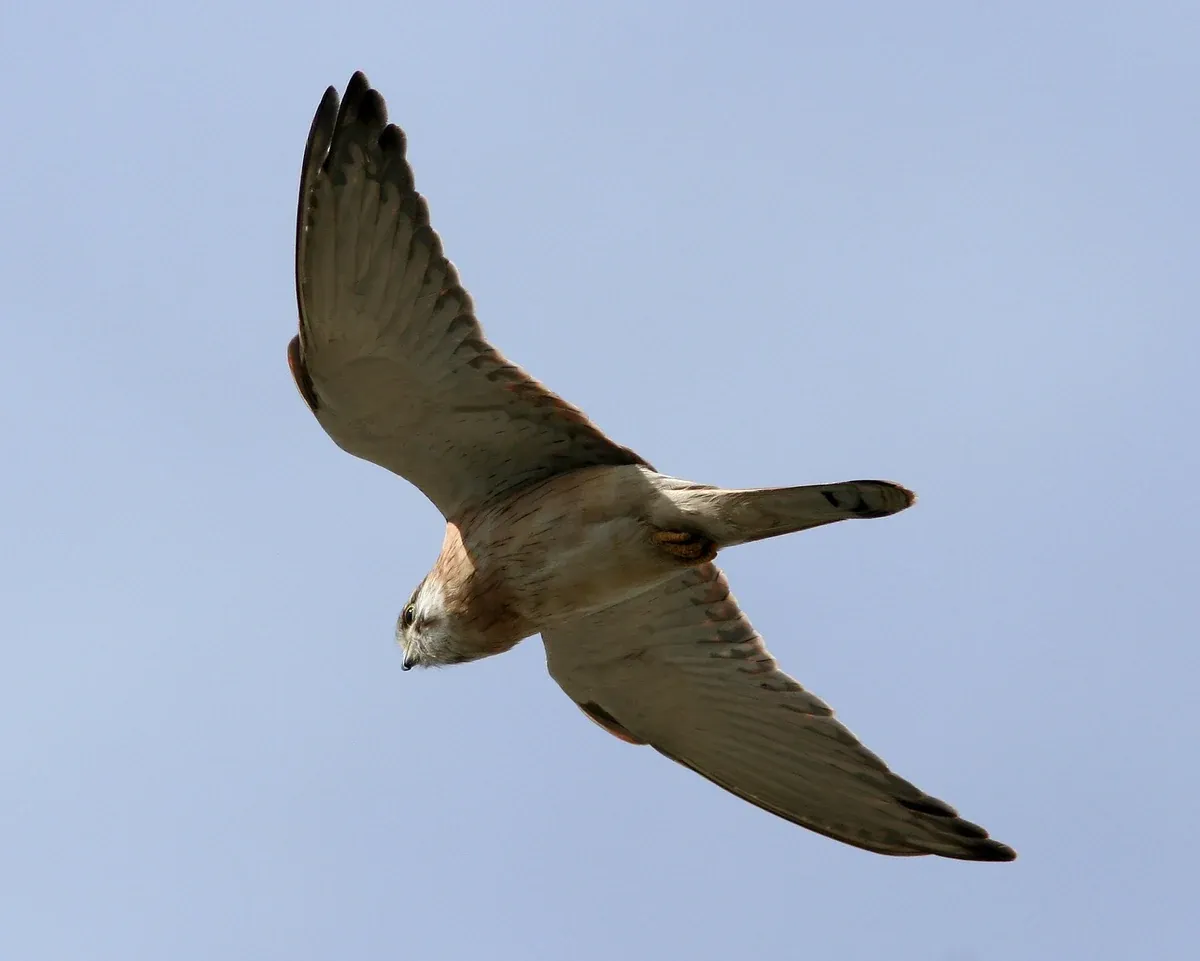
BirdLife Australia describes the Nankeen Kestrel finding prey from a perch or hovering with rapid wingbeats, its tail fanned and head and body held comparatively still. It drops closer before pouncing. Its foods include small mammals, reptiles, birds and insects; some prey can also be taken in the air or from branches.
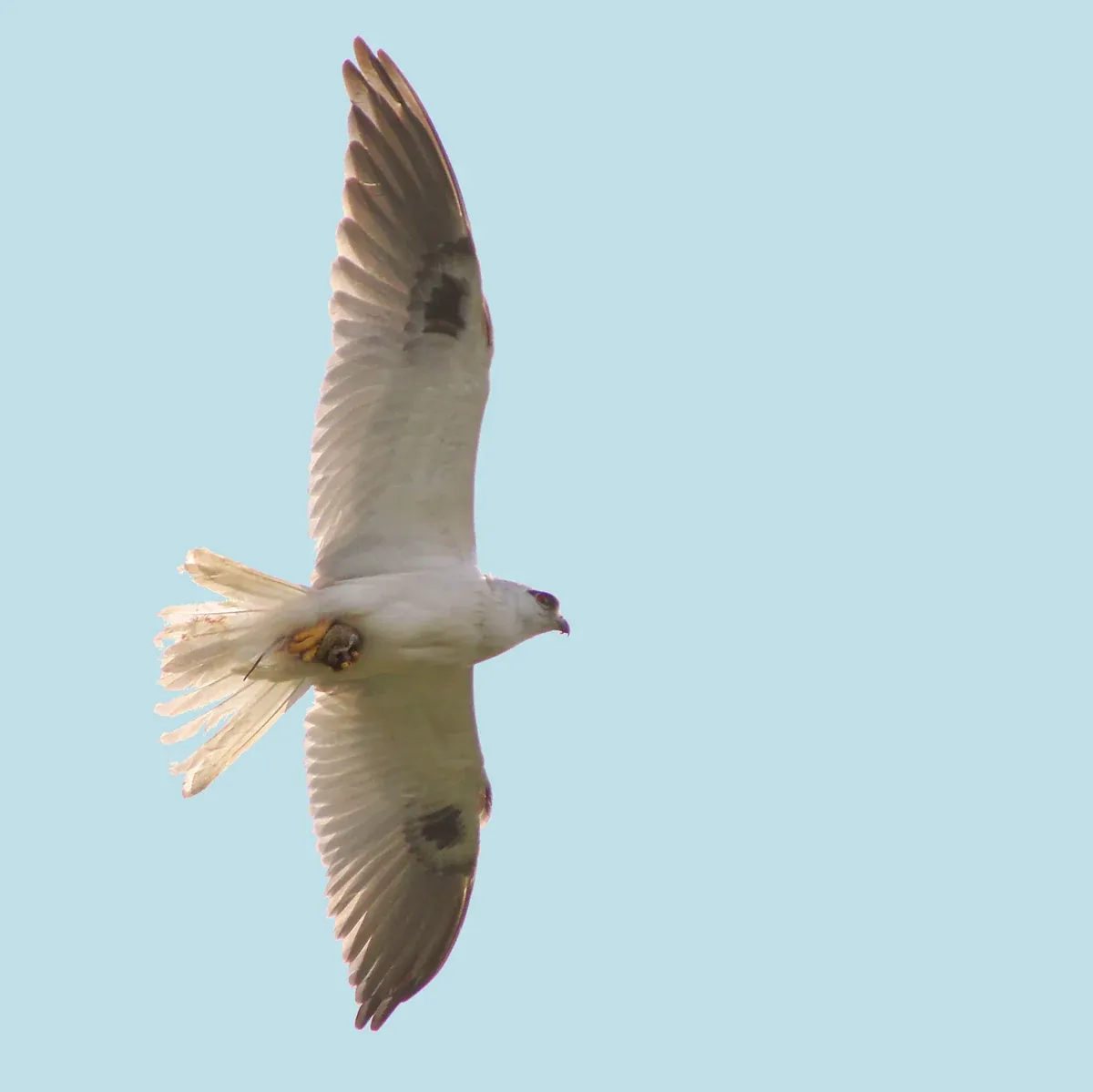
The Australian Museum describes the Black-shouldered Kite as predominantly a mouse hunter, particularly taking introduced House Mice, though insects are also eaten. It can hover with raised wings before dropping and taking prey in its talons. A kite is therefore not restricted to gliding, and a kestrel hovering over a field is not necessarily hunting mice.
Those differences also matter when describing habitat. An open hunting area can offer different foods to the two birds. Seeing one raptor catch a mouse does not establish that every hovering bird there has the same diet.
How can a bird stay in one place in moving air?
The air can move past a bird even while it stays over one patch of ground. In wind-hovering, a suitable headwind and rising air can support a kestrel without continuous wingbeats. That is different from the flapping hover often seen over flatter ground: both can look stationary to someone watching from below.
A 2024 study by Martinez Groves-Raines and colleagues measured two female Nankeen Kestrels in a wind tunnel. A ramp created rising airflow, and cameras tracked markers on the head, body, wings and tail. The researchers analysed 454 short hovering periods, deliberately selecting periods without active flapping and with very little head movement.
The apparently still birds were continually changing shape. Bending and extending the wings, spreading the tail and coordinating wing and tail positions helped maintain their position. Some movements were symmetrical; others differed between the two wings. The study measured these relationships, rather than showing that one fixed wing angle explains every hover.
Two trained birds in smooth airflow cannot represent every gust or every wild hunting bout. The study nevertheless shows why a steady head does not mean an inactive bird: small adjustments elsewhere can keep the view of the ground stable.
Compare the whole bird
The Museum describes a rufous-backed kestrel with dark markings and pale, streaked underparts. Age and sex change the details:
Scroll sideways, or focus the table and use arrow keys, to compare all columns.
| Bird | Features to compare | Limit of the shortcut |
|---|---|---|
| Adult male Nankeen Kestrel | Greyish crown and tail contrasting with the rufous back | The extent of grey varies between individuals. |
| Adult female Nankeen Kestrel | More rufous on crown and tail, usually heavier markings | A brown head does not distinguish her reliably from a juvenile. |
| Juvenile Nankeen Kestrel | Female-like plumage | Record age or sex as uncertain if the visible features do not resolve it. |
| Juvenile Black-shouldered Kite | Warm brown colouring on head and upper breast, with darker eyes than an adult | Warm colour alone does not make it a kestrel; check the kite’s overall pattern. |
An adult Black-shouldered Kite is strikingly pale grey and white, with black shoulders and dark wingtips. The red eye has a black marking extending behind it. The Museum describes shallow wingbeats alternating with glides on raised wings, another useful part of a longer observation.
Do not try to identify the bird only from an eye colour that you cannot actually see. A photograph against bright sky may lose the pale plumage detail or turn an upperwing into a dark silhouette.
Young kites complicate the colour shortcut
ABSA’s specialist account records rufous-brown on a juvenile kite’s crown, nape and upper breast, with darker eyes than an adult’s. Some of that warm colouring fades as the bird develops. “Brown means kestrel” is therefore too simple.
That account is written for trained bird study and includes measurements. Those are not a reason to approach, catch or weigh a wild bird. Even the listed male and female sizes overlap: apparent size at an unknown distance is especially weak evidence for sexing one.
These are not the only possible raptors
An unfamiliar pale kite also warrants comparison with the Letter-winged Kite, especially in inland country. Birds Queensland’s identification account emphasises its dark underwing bar, which can look like an M, compared with the smaller dark wrist patch of the Black-shouldered Kite. A perched view may hide that useful distinction; seek a natural change of angle rather than flushing the bird.
Nor does hovering eliminate a Brown Falcon. Macedon Ranges Shire Council’s bird guide describes its less steady hover, broader appearance and dark marks around the face. Treat these as alternatives to investigate when size, structure or markings do not fit the two common candidates, rather than forcing every hovering bird into the comparison.
Make a longer, safer observation
Watch from a legitimate stationary viewing place, not by stopping dangerously beside a road. Let the bird change angle naturally. Record the rufous or pale upperparts, dark shoulder pattern, tail and sequence of hovering, dropping and perching.
If the view is brief, “small hovering raptor” is an honest record. A useful identification is built from the features you saw, with uncertainty retained where the light or distance concealed them.
Illustrated explanation
Look at each bird’s outline and underwing
Illustration sources checked .


Sources: · Read the explanation in context