A brown Flame Robin is not automatically an adult female. A young male can also have female-like plumage, including after losing the streaked appearance of a recently fledged bird. That makes two separate questions important: which robin is it, and what can its current feathers establish about age or sex?
A bright male nearby does not settle either question. Watch each bird’s own features, and keep an uncertain identification uncertain. A useful record can say “Flame Robin, brown plumage, sex unknown” without throwing away the observation.
Separate plumage stage from sex
The Australian Museum’s account describes three conspicuously different appearances. Adult males have orange breast and throat, slate-grey upperparts and a white folded-wing stripe. Adult females are grey-brown, with a paler buff wing stripe and white in the outer tail. Fresh juveniles add strong streaking: buff on the brown upperparts and brown on the pale underside.
The missing stage in a simple male/female comparison is the brown, less obviously juvenile bird.
Scroll sideways, or focus the table and use arrow keys, to compare all columns.
| Appearance | What it can support | What it cannot settle alone |
|---|---|---|
| Strongly streaked young bird | Juvenile plumage, once the species is established. | Whether the bird is male or female. |
| Brown bird with little obvious juvenile streaking | Female-like plumage; consider an immature of either sex as well as an adult female. | An exact age, or an adult-female identification from brown colour alone. |
| Brown bird with a faint orange or rusty wash | A colour observation worth recording in neutral light. | A reliable sex determination; banding observations include exceptions. |
| Full orange throat and breast, grey upperparts and the matching wing pattern | The characteristic adult-male appearance. | An exact birthday, place of origin or migration route. |
This table concerns Flame Robins. The same colour words can describe another robin at a different stage, so establish the species before using it.
Why the young male does not immediately look like the adult
The Australian Bird Study Association’s banding guide describes a first-immature stage reached within months of fledging. Males and females look similar, and retain some juvenile wing and flight feathers.
Most males become distinctive at the following post-breeding moult, in their second year. Some remain female-like until the next post-breeding moult, in their third year. These describe plumage stages, not necessarily reproductive ability.
Retained feathers can help trained banders, but measurements do not definitively establish age or sex. A photograph may lack the necessary detail. Never catch a robin, spread its wing or disturb a nest to resolve an identification.
An orange wash is a clue with important exceptions
Fordyce’s 1978 banding report followed Flame Robins in northern Victoria, including 774 birds at its main Shepparton-area site.
Across the study, 58 brown birds were later recaptured in adult male plumage. Initially, 29 had no orange, 18 had a throat tinge and 11 had breast or belly colour. Absence of orange plainly did not identify a female.
Nor did orange prove a male. The observers recorded a female with an orange throat attending a nest with a coloured male. Some brown birds’ washes faded over successive years; artificial lighting also altered impressions. Fordyce explicitly rejected a simple orange-wash rule for sex or age.
That finding qualifies the compressed description of immature male colour in the banding guide. Use a combination of features and history, not one shaded patch. These were regional observations, not a national estimate of how often every exception occurs.
Flame, Scarlet or Pink Robin?
The NSW Scientific Committee’s comparison gives useful starting points for the bright males. Flame has grey upperparts and colour extending onto the throat. Scarlet has black upperparts and throat, a red breast and a larger white forehead patch. Check the boundary between the throat and breast, not just whether the chest looks red or orange in a photograph.
Brown birds are harder. A female Scarlet commonly has a reddish breast, but the exceptions in Flame Robins mean that this cannot work as a stand-alone test. Compare forehead, folded-wing pattern, tail and the bird’s overall appearance with a regional field guide.
Pink Robins add another source of confusion. Females are warm olive-brown, with buff wing markings and generally plain dark tails. A clear outer-tail view can therefore be valuable when comparing one with a brown Flame Robin. Tail feathers hidden behind a branch provide no evidence that a pale edge is absent.
Pink Robins also shift into more open habitats outside breeding, though they tend to use dense undergrowth. Habitat supports an identification; it does not guarantee it. A single familiar perch or nearby adult of another species should never substitute for the bird’s own features.
Why Flame Robins appear in different places through the year
BirdLife’s July 2026 seasonal guide highlights Flame Robins moving from higher country into open lowlands in south-eastern Australia during autumn and winter. The Australian Museum also records movements by some Tasmanian birds to the mainland. This describes a broad seasonal pattern, not one journey made by every individual.
A small flock in a winter paddock and a territorial bird in upland breeding habitat can therefore be the same species behaving in different seasonal settings. Changes in local sightings need not mean the birds have died or that their breeding population has grown.
Research helps explain why moving may be worthwhile. Robinson’s 1992 study compared Flame and Scarlet Robins at a Southern Tablelands breeding site, and studied a separate wintering Flame Robin population in coastal Victoria. Observations ran from July 1983 to May 1986.
At the shared breeding site, Flame Robins used aerial feeding more often than Scarlet Robins, which relied more on ground prey. Seasonal loss of flying insects offered an explanation for why Flame Robins left while Scarlet Robins could remain. Wintering Flame Robins also used repeated hopping and picking of small prey from the ground.
The important limit is that the researcher did not track the same population between both sites. The migration explanation was an inference from food, behaviour and seasonal conditions, not an experiment proving one trigger. A bird seen pouncing in your garden does not contradict the study: individuals can use several feeding methods, and their balance changes with the setting.
Make observations that remain useful
Record a general locality, date, habitat and the number of birds. For identification, photographs showing the forehead and throat, folded wing and outer tail are more useful together than several versions of one chest view. Note whether the bird was streaked, whether it was alone or in a group, and any feeding behaviour. Keep the original image rather than increasing colour saturation to make an uncertain wash obvious.
Watch from an existing track or a quiet position and allow the bird to choose its distance. Do not use food or repeated call playback to obtain a better view. Leave a nest or fledgling undisturbed, and keep pets away.
The species needs useful habitat across seasons. NSW’s assessment identifies loss and degradation of both breeding and winter habitat, including simplification through removal of logs and other woody material. Where safe and appropriate, retaining that structure is more useful than trying to turn a shy insect-eater into a hand-fed visitor.
If a bird is visibly injured or in immediate danger, use the injured-wildlife guide and contact licensed help. An uncertain sex or unfamiliar juvenile plumage is an identification question, not by itself a reason to intervene.
Illustrated explanation
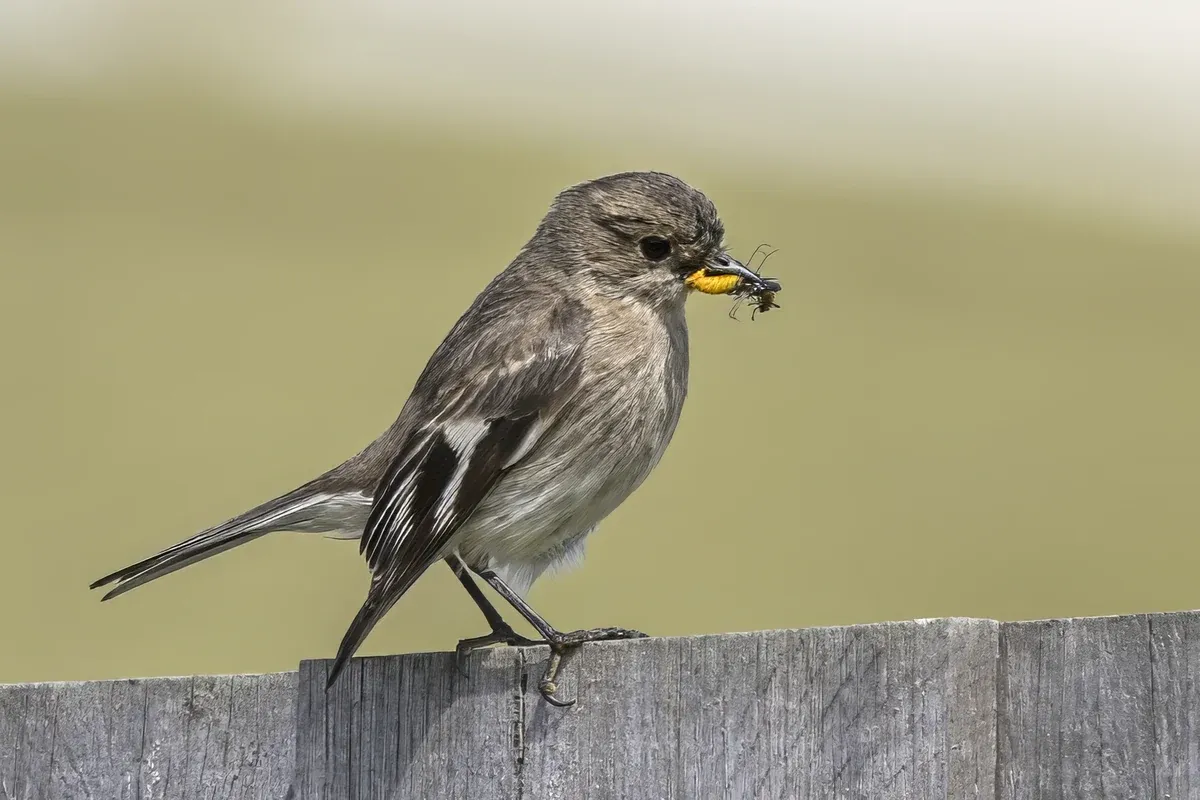
A documented juvenile example
Illustration sources checked .
Compare the patterned brown plumage with the stage descriptions above. The photograph does not establish an individual bird’s sex.

Sources: Australian Bird Study Association: Flame Robin · Read the explanation in context