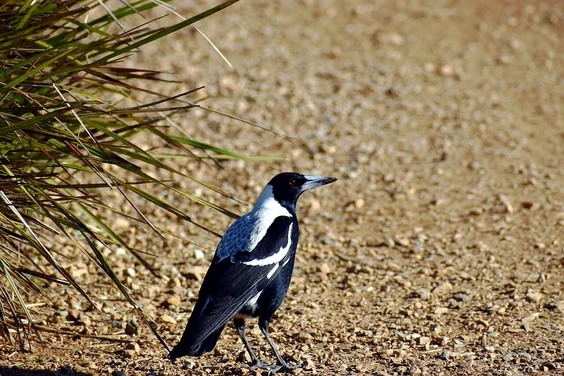
A bird chasing a drone may be defending the place where it nests, feeds or raises young. Other birds flee, interrupt feeding or become watchful. Contact can cause injury. These are different responses, and each deserves attention.
Australian research documents magpies chasing drones during the breeding season and currawongs leaving nests as a drone passes overhead. Records also describe ravens confronting delivery drones. The evidence supports taking these encounters seriously, while leaving important questions about injury frequency and longer-term effects unanswered.
For recreational wildlife watching, the clearest precaution is to use binoculars or a camera from a respectful distance on the ground. BirdLife Australia’s guidelines advise against using drones for birdwatching, because of the disturbance they can cause.
Why would a bird approach something that frightens it?
Defence can involve moving towards a threat. Mobbing includes alarm calling, repeated approaches, swooping and sometimes physical contact intended to drive an intruder away. A bird defending its territory or young may therefore close the distance to a drone instead of escaping.
Research involving Gisela Kaplan helps explain how purposeful this behaviour can be. In Armidale, NSW, Koboroff, Kaplan and Rogers tested 14 resident magpie groups with five predator models across three stages of juvenile development. The birds changed their tactics with the type of predator: aerial swooping at raptor models differed from their response to a monitor lizard on the ground. This was a predator-model experiment, not a drone test, but it shows why calling every close approach simple curiosity would be misleading. Read the original study.
We cannot know exactly what a magpie thinks a particular aircraft is. A defensive response is consistent with perceiving an intruder or threat; it does not prove that every drone is mistaken for a particular hawk.
What has been recorded for magpies, currawongs and ravens?
Lyons and colleagues published observations from 97 hours of Australian drone flights. Most bird encounters were incidental to other fieldwork, rather than a controlled test of attack frequency.
- Australian Magpies: two breeding-season chases in Sydney, in August 2015 and October 2016. Sex was not determined; this does not establish how often magpies attack.
- Pied Currawongs: left nests and called when a drone passed directly overhead, about 5–10 metres away. These birds did not attack the drone; the duration of their absence was not measured.
- Masked Lapwings: territorial calling near the drone, without further aggressive responses recorded in those encounters.
These are observations of particular birds under particular conditions, not a ceiling on what each species can do. The researchers did not see the same defensive behaviour from magpies and currawongs outside the breeding season during their observations. That does not make non-breeding flights universally harmless. Lyons and colleagues, 2018.
Ravens have a separate documentary record. The US Federal Aviation Administration’s April 2025 assessment of Wing’s proposed Texas operations describes Australian Ravens mobbing and briefly attacking delivery drones in Canberra in 2021. It records approaches from behind and damage to tail foam. This operational account supports the occurrence of raven–drone encounters; it is not a controlled Australian wildlife experiment or an independent injury survey. See page 3-18 of the assessment.
Could different species join in?
There is a plausible biological explanation for several species reacting to the same drone: each may detect the intruder, and birds can also obtain information from one another’s alarms.
In a Canberra playback experiment, Australian Magpies angled their heads higher after hearing Noisy Miner aerial alarm calls than after miner mobbing calls. Their head movements were consistent with searching where the indicated danger would be. This demonstrates that a bird can gain useful information about a threat from another species’ calls. Dawson Pell and colleagues, 2018.
However, that experiment did not use drones. The sources checked here do not establish how frequently magpies, currawongs and ravens mob a drone together, or whether such a group is coordinating an attack rather than several individuals responding independently. Repeated eyewitness observations are valuable leads for that research. They should be recorded accurately, without turning an unmeasured pattern into a percentage.
Contact injuries, feet and legs, and deaths
The Canberra raven account documents physical contact damaging drone tail material, but gives no veterinary findings about the birds. There is also a field report of injury: Audubon Connecticut reported that, during the 2021 nesting season, an American Oystercatcher suffered a leg injury after chasing and divebombing a drone. The bird subsequently recovered. The same account describes repeated drone disturbance and abandonment of a nearby Piping Plover nest. It is a conservation organisation’s report, not an injury-rate study. Read Audubon’s account.
A more severe case needs careful attribution. In a 2020 account, the Schuylkill Center’s executive director described a Peregrine Falcon found dead in Philadelphia the previous year with a severed leg. A drone encounter was suspected, but the author explicitly described that explanation as a theory. The dead bird and missing leg were reported; the drone as their cause was not established. The centre’s account.
The oystercatcher case supports a leg-injury warning. It does not establish that a propeller severed a limb. In the sources checked for this article, we could not verify a clinical case report specifically establishing drone-caused loss of a bird’s foot or leg, or a reliable Australian drone-related bird mortality rate. This is a limitation of the records available, not evidence that those injuries or deaths cannot happen.
A useful incident record separates three things: whether contact was witnessed, what injury was observed, and what a veterinarian established about its cause. A bird disappearing from view after a collision leaves its eventual outcome unknown. Similarly, footage of a bird flying away cannot substitute for an injury examination.
A 2019 study combined scientific literature with online videos to broaden the record of wildlife responses to drones. Videos can reveal encounters missed by formal surveys, but dramatic encounters are especially likely to be uploaded. They cannot tell us what proportion of all flights causes injury. Rebolo-Ifran and colleagues.
What about studies that recorded no collisions?
A different study monitored 108 survey flights, totalling 2,104 minutes, at Pulu Keeling and Christmas Island. Despite numerous close encounters with flying seabirds, the observers recorded no collisions. Flights used planned routes, a licensed pilot and a dedicated observer. Sorrell and colleagues, 2023.
This demonstrates that collisions were not inevitable under those operating conditions. It cannot give a zero-risk guarantee for another aircraft, species or setting. The paper explicitly defines its focus on safe operation as the safety of the aircraft; it did not establish the absence of every physiological, nesting or longer-term effect on wildlife.
Serious nesting losses can happen without a bird being struck
California’s wildlife agency records a major incident at Bolsa Chica Ecological Reserve on 12 May 2021. An illegally operated drone crashed, approximately 3,000 Elegant Terns left their nesting grounds, and an estimated 2,000 eggs were abandoned. The agency’s account.
These figures describe birds displaced and eggs abandoned, not 3,000 adult birds killed by propellers. The case nevertheless shows why evaluating only direct collisions misses a potentially serious consequence of disturbance. It is an event-specific record from a Californian colony, not a prediction for every Australian drone flight.
Fleeing birds face a different problem from attacking birds
A flock taking off may be trying to escape. That differs from birds actively pursuing a drone, although both responses can disrupt normal activity.
In Moreton Bay, Queensland, researchers conducted 240 approaches to mixed waterbird flocks, covering 12 species. Eastern Curlews were particularly sensitive: the tested approaches did not avoid escape flight at heights below the standard 120-metre recreational ceiling. The most sensitive species could influence the response of the whole flock. Wilson, Amano and Fuller, 2023.
That matters when an operator watches only the apparently tolerant birds. A drone may encounter a mixed group containing a more sensitive species, and one response can become a broader disturbance. This study concerned roosting flocks, not mixed-species attacks on drones.
The same research found much lower modelled flight probabilities for other studied species at greater heights. Those results do not supply a universal safe altitude. Aircraft noise, speed, visibility and approach distance also mattered. Nor is exceeding the legal height limit an acceptable way to avoid disturbing a sensitive flock: the appropriate choice may be to avoid that location altogether.
Shape, flight path and behaviour matter as well as size
A drone’s approach is part of the encounter. Moving directly towards birds, banking nearby or launching close to them may produce a different response from passing on a distant, predictable route.
At two NSW waterfowl sites, McEvoy and colleagues compared several aircraft configurations. Direct approaches and some banking manoeuvres produced stronger responses; the authors considered resemblance to an aerial predator a possible explanation. A small quadcopter flown low also caused ducks to swim out of the camera’s view without taking flight. The 2016 field study.
This is useful for two reasons. A smaller aircraft is not automatically less disturbing, and a count of birds that flew away can miss birds displaced by swimming or walking. The field comparisons also differed in site and equipment, so they should not be turned into a simple league table of safe drone brands.
A nesting bird that stays put may still be affected
Studies measure different outcomes. Looking up, calling, moving away, attacking, changes in heart rate and breeding failure are not interchangeable measures of harm.
A meta-analysis of 149 studies, published online in 2024 and in the 2025 journal volume, found that birds away from nests were more likely to move away than birds at nests. Its analysis included walking, swimming and flying away; alarm calling and vigilance were excluded because reporting was inconsistent. Less movement therefore cannot establish that an incubating bird experiences less disturbance overall. Brisson-Curadeau and colleagues.
In a Texas study of nesting colonial waterbirds, drone flights did not significantly increase escape behaviour across the colony as a whole at the tested heights. Yet broader disturbance increased at the lowest tested height, and Laughing Gulls showed a species-specific escape response that the colony-wide result obscured. The study did not measure subsequent breeding success. Barr and colleagues, 2020.
For someone watching a nest, the practical implication is straightforward: do not use an adult’s reluctance to leave its eggs as permission to move closer.
Do birds get used to drones?
Sometimes the visible response diminishes. At one Melbourne waterbird site, researchers flew 50 flights over roughly four hours on a single non-breeding-season day. Most recorded species–drone encounters produced no visible response; vigilance accounted for most of the remainder, and responses became weaker later in the sequence. Howell and colleagues, 2023.
That is evidence of reduced responses in that setting. The birds were not individually marked, flight heights followed a sequence, and the study did not establish long-term welfare outcomes. It is not a reason to repeatedly fly at a wild bird until it stops reacting.
What about koalas, kangaroos and other animals?
The visible response is only one part of the evidence. A study of free-ranging American black bears found elevated heart rates during drone flights even when behavioural changes were limited. This demonstrates why physiology can reveal effects that observation misses; it does not provide a stress estimate for Australian birds. Ditmer and colleagues, 2015.
Australian results also depend on the circumstances. At Cleland Wildlife Park in South Australia, a koala study found a brief increase in vigilance but no detected heart-rate or breathing-rate change during its tests. These were captive animals, and the result does not establish that wild koalas always tolerate similar flights. Colombelli-Negrel and colleagues, 2023.
A Tasmanian study published on 9 November 2026 examined Forester Kangaroos and Bennett’s Wallabies. Lower flights generally produced more vigilance and escape responses, particularly at 40 metres and below. The work measured behaviour, not subsequent survival or reproductive success. Its findings are another reason to account for species and height, rather than a universal clearance to fly above a particular animal. Teo and colleagues.
Why do conservation researchers use drones?
Carefully designed surveys can obtain information that would otherwise require people to enter difficult terrain or approach colonies. The relevant comparison is the disturbance and usefulness of the available methods for that particular conservation question.
One influential experiment tested counting accuracy using ten replica seabird colonies with known numbers of model birds. Counts from drone images outperformed ground observers. Because the birds were replicas, this was a strong test of counting performance but could not test animal welfare. Hodgson and colleagues, 2018.
Scientific usefulness and wildlife protection have to be assessed together. Research permits, ethics review, trained observers and a plan to stop when birds react are meaningful parts of that assessment. A permitted research flight does not establish that recreational approaches at the same site are appropriate.
Are drone light shows better for wildlife than fireworks?
A light show may avoid the explosive bangs and combustion products of pyrotechnic fireworks. Those are real differences in how the displays work. The Curtin-led review of fireworks impacts discusses alternatives, including drones, while also recognising that drones themselves can disturb wildlife. Bateman, Gilson and Bradshaw, 2023.
It is too broad to call an aerial light show wildlife-safe simply because it replaces fireworks. Many lit aircraft operating at night present a different exposure from a single daytime survey drone. The studies checked here do not establish a reliable wildlife mortality comparison between a Sydney fireworks display and a proposed drone replacement. A percentage from a daytime bird-survey experiment cannot answer that question.
Light needs its own assessment. Australian Government guidance explains that artificial lighting can disorient birds and interfere with habitat use and seabird fledging. That general evidence gives reasons to consider lighting carefully; it does not quantify the effects of a particular drone show. Australian wildlife lighting guidance.
NYC Bird Alliance likewise describes the research on drone shows as limited and recommends avoiding sensitive places and periods. Its North American migration calendar should not be copied into Australian event planning. Local species, roosts, breeding activity and flight paths need local assessment. Its drone-show guidance.
For an Australian event, useful questions include who has assessed the site, which animals use it after dark, how rehearsal flights are included, and what observations would trigger a change or cancellation. See our separate examination of Sydney fireworks, wildlife and pets for the evidence on fireworks themselves.
Australian rules and wildlife precautions
These requirements were checked on 14 November 2026. Recheck the official guidance before a flight; land-management and wildlife restrictions apply alongside aviation rules.
- CASA’s standard recreational rules include a maximum height of 120 metres above ground, daylight flying, keeping the aircraft within unaided visual line of sight, and separation from people. They also restrict flying near airports and emergency operations. This is not the complete rule set, and 120 metres is a legal ceiling rather than a wildlife safety buffer. Read CASA’s current rules.
- In NSW national parks, approval is required before launching, landing or operating a drone from within a park. Some areas exclude recreational drones. Check the specific park and approval conditions. NSW parks policy.
- Around NSW marine mammals, special approach restrictions apply to drones near whales, dolphins, dugongs and seals. Check the current guidance for the relevant height and horizontal restrictions, including stricter requirements in particular cases. A whale-watching flight must also account for nearby birds. NSW’s marine-mammal guidance and approach rules.
Before an otherwise permitted recreational flight, choose a place away from wildlife concentrations, nests and roosts. Queensland Parks specifically warns against direct approaches and flights near wildlife. If animals begin calling, pursuing the drone or moving away, end the encounter safely and leave the area rather than repeating the approach for footage. Queensland Parks’ wildlife advice.
Do not improvise an escape manoeuvre that breaches aviation rules or creates another hazard. Avoiding the encounter is safer than relying on outmanoeuvring a defending bird.
If you witness a strike or find an injured bird
Contact a licensed wildlife rescue group or vet promptly. Keep people and pets back, observe from a safe distance, and describe what you saw. Follow the rescuer’s instructions; do not chase, handle or attempt treatment yourself. WIRES specifically identifies raptors and several other native animals as requiring specialist handling. Emergency rescue guidance.
For a report, record the time, location, species if known, aircraft behaviour and whether you actually saw contact. Preserve existing photographs or video without approaching a nest or repeating the flight. Give sensitive nest locations privately to the relevant authority.
CASA handles aviation-safety complaints and directs wildlife matters to state wildlife agencies. A wildlife incident and an unsafe flight may therefore need separate reports. CASA’s reporting guidance explains that distinction; our injured-wildlife guide helps you find the appropriate immediate help.